






Davis' Big-headed Ant
Pheidole davisi
Davis' Big-headed Ant is a small ant known for its big head! These ants work together in groups and are often found in gardens and forests. They are very busy and love to explore!
Lebensraum: Forests
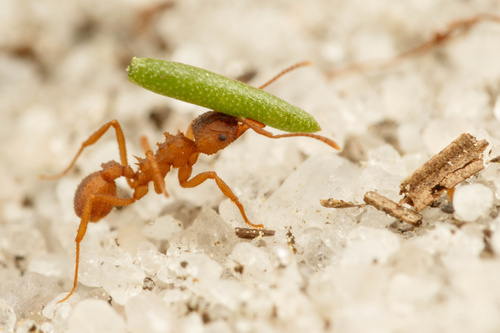
The Davis' Big-headed Ant has two distinct worker forms: smaller minor workers and larger major workers with disproportionately massive, shiny, reddish-brown heads. Its body is also reddish-brown to dark brown, appearing smooth and somewhat glossy. The major's powerful head is its most distinguishing feature.
Kategorie
InsektenSeltenheit
Common
Gefahr
2/5 · Gering
Snaps
Mach den ersten Snap!
A single queen can live for several years, laying thousands of eggs in her lifetime!
Major workers can block nest entrances with their huge heads, acting as living doors!
These ants are super fast diggers, creating complex tunnels underground for their homes.
They clean up their environment by scavenging dead insects and plant material.
Davis' Big-headed Ant has powerful jaws on its large-headed soldiers that help them crush tough seeds and defend the colony from threats.
Davis' Big-headed Ant can lay invisible scent trails because of special glands that helps them guide fellow workers to newly found food sources.
Davis' Big-headed Ant can lift objects many times its own body weight because of its strong exoskeleton and muscles that help them carry food back to the nest.
These ants are omnivores, eating almost anything from tiny insects to sweet plant juices.

Phrynosoma cornutum
A favorite prey for this unique reptile in their shared habitats.
Rhopalosiphum maidis
They collect sugary honeydew produced by these tiny plant sap-suckers.
Musca domestica
Scavenges dead flies and other small insects for protein.
Solenopsis invicta
Often preyed upon by aggressive invasive fire ants in battle.
Soziale Tiere leben in organisierten Gruppen und kooperieren, um ihr Überleben zu sichern, beispielsweise bei der Nahrungssuche, Verteidigung und Aufzucht der Jungen.
Dieses Merkmal kennzeichnet Organismen, deren Ernährung sowohl pflanzliche als auch tierische Bestandteile umfasst.
Waldlebensräume sind terrestrische Lebensräume, die von dichtem Baumbestand dominiert werden und eine große Vielfalt an Pflanzen- und Tierarten beherbergen.
Beschreibt Organismen, die totes organisches Material abbauen und Nährstoffe in das Ökosystem zurückführen.

Bezieht sich auf Arten, die deutlich kleiner sind als der Durchschnitt oder das Typische ihrer Art.

Tagaktive Tiere sind hauptsächlich bei Tageslicht aktiv und ruhen oder schlafen in der Regel nachts.

Beschreibt Organismen, die Pollen übertragen und so die Befruchtung und Fortpflanzung von Pflanzen ermöglichen.
Noch keine Alternativnamen vorhanden.
Gefahr
2/5 · Gering
Be careful not to disturb ant nests, as they can bite if they feel threatened.
1.8-5 mm
60-90 Tage
These ants are omnivores, eating almost anything from tiny insects to sweet plant juices.
Forests
Foraging
6
20000
Zoome hinein, um Cluster aufzulösen und zu sehen, wo dieses Objekt fotografiert wurde.
Neueste Snaps erscheinen hier, wenn neue Beobachtungen hinzukommen.








.jpg&width=800)





