






Deertongue
dichanthelium clandestinum
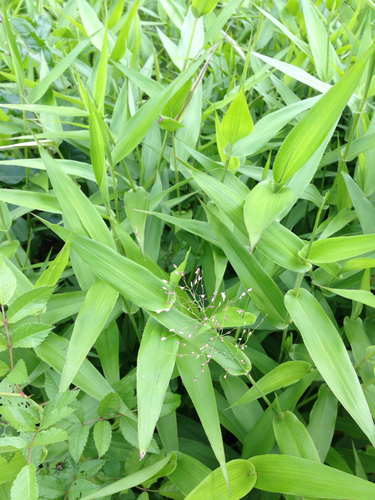
Deertongue is a soft, grassy plant that can be found in many forests and meadows! Its leaves are shaped like tongues, and they dance in the breeze, making it fun to watch!
Lebensraum: Deertongue grows in forests, meadows, and grasslands, often in shaded areas.
The Deertongue has broad, flat, tongue-shaped leaves, often quite hairy and rough to the touch. Its sturdy, upright stems can reach up to three feet tall. The flowers are tiny, green spikelets, often hidden among the leaves or along the stem.
Kategorie
PflanzenSeltenheit
Common
Gefahr
0/5 · Keine bekannte Gefahr
Snaps
Mach den ersten Snap!
Deertongue can prevent soil erosion on hillsides by forming a dense mat with its roots!
Find it often near wetlands or shady woods, where it loves the moist, rich soil!
Its scientific name 'clandestinum' means 'hidden,' referring to its tiny, often unseen flowers!
This grass is a super snack for deer and other grazers, helping them stay full and healthy.
Deertongue can grow well in low light, helping it thrive in the shadowy understory of forests where other plants struggle.
Deertongue has rhizomes, underground stems that help it spread efficiently and form dense, stable colonies.
Deertongue's hairy leaves can help collect dew and moisture from the air, assisting its survival in drier spells.
Odocoileus virginianus
A common browser of its leaves and stems

Peromyscus leucopus
Feeds on its small seeds and plant parts

Melanoplus differentialis
Chews on its leaves and tender shoots
Cardinalis cardinalis
Uses dense clumps for cover and nesting
Farbenfroh beschreibt Organismen oder Objekte, die eine große Vielfalt an leuchtenden und deutlich erkennbaren Farben aufweisen.
Grasland-Lebensräume sind terrestrische Biome, die von Gräsern und krautigen Pflanzen dominiert werden und einer Vielzahl von Weidetieren als Lebensraum dienen.
Dieses Merkmal kennzeichnet Lebewesen, deren Ernährung vollständig oder hauptsächlich aus pflanzlichem Material besteht.
Waldlebensräume sind terrestrische Lebensräume, die von dichtem Baumbestand dominiert werden und eine große Vielfalt an Pflanzen- und Tierarten beherbergen.

Tagaktive Tiere sind hauptsächlich bei Tageslicht aktiv und ruhen oder schlafen in der Regel nachts.
Gefahr
0/5 · Keine bekannte Gefahr
Noch keine besonderen Sicherheitshinweise.
30-90 cm
30-60 cm
0.3-0.4 cm
Late spring to summer
Nein
Keine
Mehrjährig
Wind
Zoome hinein, um Cluster aufzulösen und zu sehen, wo dieses Objekt fotografiert wurde.
Neueste Snaps erscheinen hier, wenn neue Beobachtungen hinzukommen.
















_em_um_fim_de_tarde_em_Bag%C3%A9-RS.jpg&width=800)

