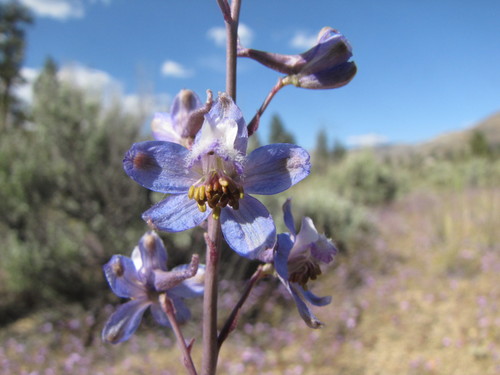


Desert Larkspur
delphinium parishii
The Desert Larkspur (Delphinium parishii) is an eye-catching perennial wildflower native to the arid desert regions of the southwestern United States and northwestern Mexico. Rising elegantly from sandy or gravelly soils, this resilient plant stands out against the dusty, muted desert landscape with its striking spikes of brilliant blue to lavender blossoms. Despite its delicate appearance, it is highly adapted to thrive in harsh, water-scarce environments where few other flowering plants can survive.
Lebensraum: Typically found growing in dry sandy or gravelly soils across desert scrub, creosote bush scrub, and Joshua tree woodlands.
This plant typically grows between 20 to 60 centimeters tall, featuring erect, slender stems that support a terminal cluster of 5 to 25 flowers. The blossoms are characterized by a distinctive, backward-pointing spur that measures about 1 to 2 centimeters long, with petals that range from pale sky-blue to deep royal blue, and occasionally white. Its leaves are deeply lobed and palmate, concentrated mostly at the base of the stem, and they often wither by the time the flower spike reaches full bloom to conserve vital moisture.
Kategorie
PflanzenSeltenheit
Common
Gefahr
1/5 · Sehr gering
Snaps
Mach den ersten Snap!
Every part of the Desert Larkspur is highly toxic, containing neuromuscular blocking chemicals that can be fatal to cattle if consumed in large quantities.
Native American tribes historically used the crushed blue flowers of this species to create rich pigments and dyes for coloring items and rituals.
The name 'Larkspur' originates from the spur-like petal structure at the back of the flower, which resembles the hind claw of a lark.
Produces highly toxic diterpene alkaloids throughout its tissues to deter herbivores and insects from grazing on it.
Sheds its foliage and goes dormant early during extreme drought or heat to preserve moisture in its deep taproot.
Utilizes a deep floral spur that physically restricts nectar access to specialized pollinators with long tongues, ensuring efficient pollination.
As a photosynthetic plant, the Desert Larkspur manufactures its own energy using sunlight, water, and carbon dioxide.
Hyles lineata
Provides nectar and receives pollination services from the White-lined Sphinx Moth.
Anthophora linsleyi
Specialized native bees visit the blooms to collect nectar, acting as efficient pollinators.
Aphis rociadae
A specialized aphid that sucks nutrient-rich sap from the stems and leaves of the larkspur.
Für dieses Objekt sind noch keine Merkmal-Badges vergeben.
Noch keine Alternativnamen vorhanden.
Sammlungen für dieses Objekt erscheinen hier, wenn weitere Themen hinzugefügt werden.
Gefahr
1/5 · Sehr gering
Noch keine besonderen Sicherheitshinweise.
Der einfachste Weg, Desert Larkspur zu bestimmen, ist die Verwendung der Naturführer-App Snappit.
20-60 cm
2-10 Jahre
As a photosynthetic plant, the Desert Larkspur manufactures its own energy using sunlight, water, and carbon dioxide.
Typically found growing in dry sandy or gravelly soils across desert scrub, creosote bush scrub, and Joshua tree woodlands.
Zoome hinein, um Cluster aufzulösen und zu sehen, wo dieses Objekt fotografiert wurde.
Neueste Snaps erscheinen hier, wenn neue Beobachtungen hinzukommen.