

Desert Paintbrush
castilleja chromosa
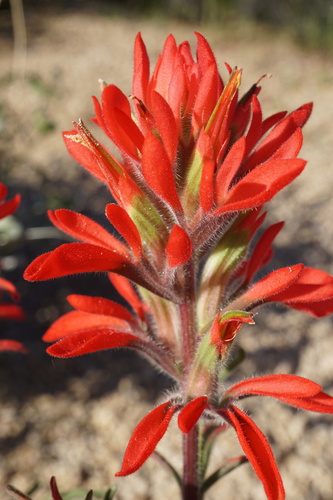
The Desert Paintbrush (Castilleja chromosa) is a striking perennial wildflower native to the arid sagebrush plains and rocky slopes of western North America. Renowned for its brilliant, flame-colored bracts, this species brings vibrant splashes of red and orange to dry landscapes. However, beneath its stunning appearance lies an intriguing ecological secret: it is a hemiparasite. While it possesses green leaves and can perform photosynthesis, it relies heavily on neighboring plants for survival. By underground root connections, it actively steals water and essential nutrients from its hosts, allowing it to survive in incredibly harsh and dry conditions.
Lebensraum: Typically found on dry, open plains, rocky hillsides, and sagebrush scrublands across western North America.
This plant typically features upright, hairy stems growing between 10 and 40 centimeters tall, covered in grayish-green, lance-shaped leaves. The true flowers are inconspicuous, green, narrow tubes, but they are surrounded by highly showy, deeply lobed bracts that blaze with a bright red to orange-red coloration, mimicking the appearance of a brush dipped in paint.
Kategorie
PflanzenSeltenheit
Common
Gefahr
1/5 · Sehr gering
Snaps
Mach den ersten Snap!
Because they are parasitic on other plants, Desert Paintbrush is notoriously difficult to cultivate in home gardens and rarely survives transplanting.
Native American tribes historically used decoctions of the plant to treat various ailments, and some used the flowers as a colorful hair ornament.
The true flowers are actually small, green, and completely hidden inside the brilliant red and orange leaf-like bracts.
It utilizes specialized root structures called haustoria to penetrate and attach to the roots of host plants, siphoning off water and nutrients.
The entire plant is covered in fine, bristly hairs that trap a layer of air, dramatically reducing evaporation caused by dry desert winds.
The intense crimson and orange colors of its bracts specifically target the visual spectrum of hummingbirds, ensuring efficient pollination in sparse environments.
It produces a portion of its own energy via photosynthesis but relies on host plants to provide water, minerals, and complex organic compounds.
Altersunterschiede: Seedlings are fully self-sufficient initially but must attach to a host plant root system within their first season to survive long-term.
Artemisia tridentata
The Desert Paintbrush taps into the root systems of this dominant shrub to absorb water and essential nutrients.
Selasphorus platycercus
This hummingbird species feeds on the nectar within the tubular flowers, providing crucial pollination services in return.
Für dieses Objekt sind noch keine Merkmal-Badges vergeben.
Noch keine Alternativnamen vorhanden.
Sammlungen für dieses Objekt erscheinen hier, wenn weitere Themen hinzugefügt werden.
Gefahr
1/5 · Sehr gering
Noch keine besonderen Sicherheitshinweise.
Der einfachste Weg, Desert Paintbrush zu bestimmen, ist die Verwendung der Naturführer-App Snappit.
10-40 cm
0.02-0.15 kg
3-10 Jahre
It produces a portion of its own energy via photosynthesis but relies on host plants to provide water, minerals, and complex organic compounds.
Typically found on dry, open plains, rocky hillsides, and sagebrush scrublands across western North America.
Parasitism
Zoome hinein, um Cluster aufzulösen und zu sehen, wo dieses Objekt fotografiert wurde.
Neueste Snaps erscheinen hier, wenn neue Beobachtungen hinzukommen.








