

Desert Sunflower
geraea canescens
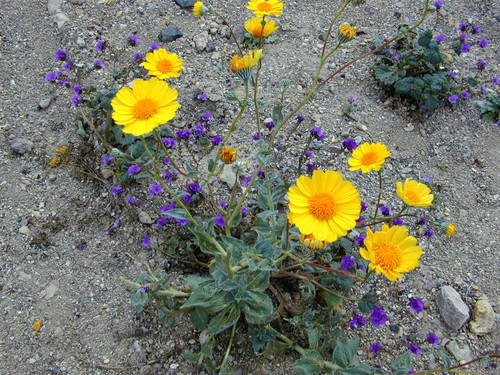
The Desert Sunflower (Geraea canescens), also known as desert gold, is an annual wildflower native to the extremely arid environments of southwestern North America. In years with high winter rainfall, this resilient plant undergoes spectacular mass bloomings, transforming barren, gravelly desert soils into vibrant, endless fields of bright yellow. Belonging to the Asteraceae (sunflower) family, it serves as a critical ephemeral resource in desert ecosystems, providing nectar for native bees and abundant seeds for desert-dwelling birds and rodents.
Lebensraum: Found in sandy desert soils, gravelly flats, and desert washes throughout the Mojave and Sonoran deserts.
This annual herb grows up to 100 cm in height, with slender, branching stems densely covered in stiff, white hairs. The bright yellow flower heads are 3 to 5 cm in diameter, featuring a central disc of yellow disc florets surrounded by 10 to 21 distinct, notched ray petals. Its gray-green leaves are lance-shaped, rough-textured, and deeply veined, clustered mostly near the lower portion of the hairy stems.
Kategorie
PflanzenSeltenheit
Common
Gefahr
1/5 · Sehr gering
Snaps
Mach den ersten Snap!
During highly anticipated desert 'superblooms', Desert Sunflowers can cover entire valley floors in gold, creating patterns visible from space.
The desert Cahuilla people traditionally collected the plant's oil-rich seeds, grinding them into a fine meal or paste for consumption.
The genus name 'Geraea' comes from the Greek word 'geraios', meaning 'old man', which refers to the white, hoary hairs on the plant's seeds and stems.
Densely covered in white, hoary hairs that trap moisture, reduce wind-flow over stomata, and reflect harsh sunlight to prevent transpiration.
Germinates quickly after rare winter rains, rapid-blooming and seeding before the extreme, lethal summer heat begins.
Young flower buds track the path of the sun across the sky to maximize solar absorption and accelerate growth.
As a photosynthetic plant, it synthesizes its own energy from sunlight, water, and carbon dioxide while extracting inorganic nutrients from dry, sandy soils.
Dipodomys deserti
Feeds on the oily seeds, caching them in burrows as a primary food source.
Gopherus agassizii
Consumes the blossoms and nutrient-dense leaves as a valuable water source in spring.
Diadasia enavata
Visits the vibrant flower heads to gather nectar, acting as a key pollinator.
Für dieses Objekt sind noch keine Merkmal-Badges vergeben.
Noch keine Alternativnamen vorhanden.
Sammlungen für dieses Objekt erscheinen hier, wenn weitere Themen hinzugefügt werden.
Gefahr
1/5 · Sehr gering
Noch keine besonderen Sicherheitshinweise.
Der einfachste Weg, Desert Sunflower zu bestimmen, ist die Verwendung der Naturführer-App Snappit.
10-100 cm
0.05-0.5 kg
1 Jahre
As a photosynthetic plant, it synthesizes its own energy from sunlight, water, and carbon dioxide while extracting inorganic nutrients from dry, sandy soils.
Found in sandy desert soils, gravelly flats, and desert washes throughout the Mojave and Sonoran deserts.
Photosynthesis
Zoome hinein, um Cluster aufzulösen und zu sehen, wo dieses Objekt fotografiert wurde.
Neueste Snaps erscheinen hier, wenn neue Beobachtungen hinzukommen.

California, US
Hier kann man sehen Kreosotbusch, Desert Holly und Cottontop Cactus.
Führer anzeigen →

California, US
Hier kann man sehen Iodinebush, Yerba Mansa und Golden Gilmania.
Führer anzeigen →

California, US
Hier kann man sehen Desert Holly, Desert Sunflower und Desert Fivespot.
Führer anzeigen →