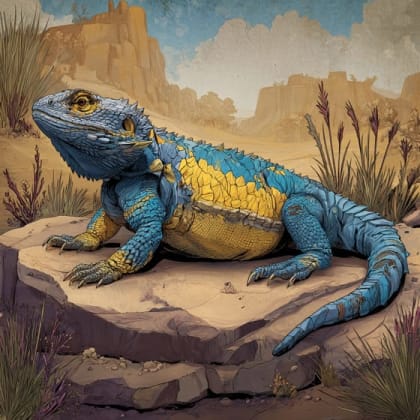
Dominican Anole
anolis oculatus
The Dominican Anole is a small and colorful lizard that can change its color to blend in with its surroundings. It loves to bask in the sun on tree branches and is often seen darting around in search of tasty insects.
Lebensraum: Tropical forests and gardens in the Dominican Republic.
The Dominican Anole is a small lizard with a slender body, often mottled with shades of green, brown, and gray. Males display a large, colorful throat fan (dewlap), which can be yellow, orange, or red.
Kategorie
ReptilienSeltenheit
Common
Gefahr
0/5 · Keine bekannte Gefahr
Snaps
Mach den ersten Snap!
Each male lizard defends a small area, like his own private backyard, from other males.
Male Dominican Anoles perform push-ups and head-bobs to show off their strength!
Sometimes they drink water by licking dew drops off leaves in the morning sun.
They are found only on the Caribbean island of Dominica, nowhere else in the world!
Dominican Anole can change its skin color from light to dark because it helps them blend perfectly with their surroundings.
Dominican Anole has special scales on its toe pads that help them cling to almost any surface, even smooth leaves and glass.
Dominican Anole can flash a vibrant throat fan (dewlap) that helps them communicate with other anoles and attract mates.
Dominican Anole can detach its tail when caught by a predator, which helps them escape while the tail wiggles to distract.
They munch on tiny insects and spiders, sometimes even sipping on sweet nectar!
Alsophis sibonius
Hunts them among leaves and branches on the ground.
Formica fusca
Actively hunts ants on tree trunks and leaves.
Falco sparverius
Raptors swoop down to catch anoles from above.
Einzelgänger leben den größten Teil ihres Lebens allein und interagieren mit Artgenossen nur zur Paarung oder zur Aufzucht der Jungen.
Baumbewohnende Tiere leben hauptsächlich in Bäumen und nutzen diese als Unterschlupf, Nahrungsquelle und zum Schutz vor Raubtieren.
Farbenfroh beschreibt Organismen oder Objekte, die eine große Vielfalt an leuchtenden und deutlich erkennbaren Farben aufweisen.
Dieses Merkmal kennzeichnet Organismen, deren Ernährung vollständig oder hauptsächlich aus tierischem Gewebe besteht.

Tagaktive Tiere sind hauptsächlich bei Tageslicht aktiv und ruhen oder schlafen in der Regel nachts.
Gefahr
0/5 · Keine bekannte Gefahr
Noch keine besonderen Sicherheitshinweise.
15-25 cm
0.003-0.008 kg
2-5 Jahre
10 km/h
They munch on tiny insects and spiders, sometimes even sipping on sweet nectar!
Tropical forests and gardens in the Dominican Republic.
Ambush
1
Zoome hinein, um Cluster aufzulösen und zu sehen, wo dieses Objekt fotografiert wurde.
Neueste Snaps erscheinen hier, wenn neue Beobachtungen hinzukommen.