

Donkey Tail
euphorbia myrsinites
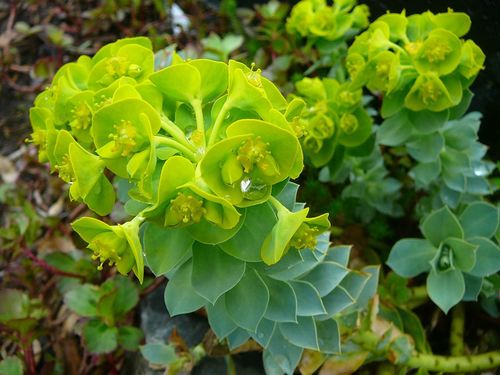
Donkey Tail, also commonly known as Myrtle Spurge, is an eye-catching, drought-tolerant succulent perennial native to the rocky landscapes of southeastern Europe and Asia Minor. This plant is renowned for its architectural beauty, featuring sprawling stems wrapped in spirally arranged, fleshy blue-green leaves. In late winter to spring, it produces vibrant, crown-like clusters of sulfur-yellow bracts that surround its small, inconspicuous flowers, making it a popular choice for rock gardens and xeriscaping. However, it is also notorious for its highly toxic, milky white latex sap, which protects it from herbivores but can cause severe irritation to human skin and eyes. In several parts of North America, it has escaped cultivation to become an aggressive, invasive weed that displaces native flora.
Lebensraum: Typically found on dry, sun-drenched rocky slopes, limestone cliffs, and disturbed gravelly open areas.
This low-growing perennial features creeping or decumbent stems measuring 10 to 40 cm long, which are densely clad in thick, fleshy, wedge-shaped leaves of a glaucous blue-grey color. The leaves are organized in tight, geometric spirals around the stems, resembling a scaly tail. In early spring, the stem tips bear conspicuous terminal clusters of bright, chartreuse or sulfur-yellow bracts that slowly age to a warm reddish-pink hue as the seeds mature inside the central capsules.
Kategorie
PflanzenSeltenheit
Common
Gefahr
1/5 · Sehr gering
Snaps
Mach den ersten Snap!
Despite its common name 'Donkey Tail', it is completely unrelated to the harmless trailing houseplant Sedum morganianum, which shares the same name.
Its milky sap is so toxic that it can cause temporary blindness if it accidentally comes into contact with human eyes.
When the seed pods dry out in summer, they burst open with an audible popping sound, shooting seeds up to 15 feet away.
Produces a sticky, caustic milky white sap containing diterpene esters that deter herbivores and can cause chemical burns on skin.
Stores water efficiently within its thick, fleshy leaves covered in a waxy, light-reflecting cuticle to survive extreme drought.
Utilizes a mechanical seed-pod mechanism that explodes when dry, launching seeds several meters away to colonize new soil.
As a photosynthetic plant, it converts solar energy, carbon dioxide, and water into sugars while absorbing essential minerals through its deep taproot.
Hyles euphorbiae
The caterpillar of this specialized moth feeds almost exclusively on the toxic leaves, sequestering the plant's poisons for its own defense.
Apis mellifera
Visits the small spring flowers to collect nectar and pollen, acting as a primary pollinator.
Bromus tectorum
Competes directly with this plant for moisture, light, and space in dry, degraded habitats of the American West.
Für dieses Objekt sind noch keine Merkmal-Badges vergeben.
Noch keine Alternativnamen vorhanden.
Sammlungen für dieses Objekt erscheinen hier, wenn weitere Themen hinzugefügt werden.
Gefahr
1/5 · Sehr gering
Noch keine besonderen Sicherheitshinweise.
Der einfachste Weg, Donkey Tail zu bestimmen, ist die Verwendung der Naturführer-App Snappit.
10+ cm
0.1+ kg
3+ Jahre
As a photosynthetic plant, it converts solar energy, carbon dioxide, and water into sugars while absorbing essential minerals through its deep taproot.
Typically found on dry, sun-drenched rocky slopes, limestone cliffs, and disturbed gravelly open areas.
Zoome hinein, um Cluster aufzulösen und zu sehen, wo dieses Objekt fotografiert wurde.
Neueste Snaps erscheinen hier, wenn neue Beobachtungen hinzukommen.



















