

Dragon'S Mouth
arethusa bulbosa
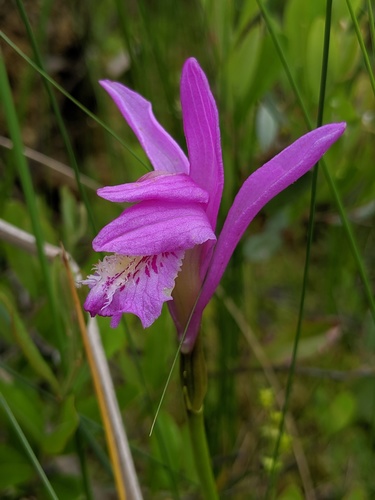
The Dragon's Mouth orchid (Arethusa bulbosa) is one of North America's most captivating and elusive wild orchids. Rising from the damp sphagnum moss of northern bogs, this delicate perennial produces a single, dramatic magenta flower that seems to defy the harsh, nutrient-poor conditions of its wetland home. Because of its specific ecological needs and reliance on pristine habitats, finding a blooming Dragon's Mouth is a celebrated event for botanists and nature enthusiasts alike. It represents the fragile beauty of bog ecosystems, captivating observers with its intense coloration and complex evolutionary strategy. Its unique shape and specialized lifestyle make it a crowning jewel of wetland flora.
Lebensraum: Typically found nestled in acidic, wet sphagnum bogs, fens, and open coniferous swamps.
Growing between 10 to 40 centimeters tall, the Dragon's Mouth features a single, erect stem topped with a solitary, vibrant pink-to-magenta flower. The blossom is distinguished by a highly detailed, downward-arching lip or labellum that is white to pale yellow, adorned with brilliant purple streaks, spots, and a fringed crest of yellow fleshy hairs. A single, grass-like leaf is present but remains inconspicuous, only fully developing after the flower has begun to fade.
Kategorie
PflanzenSeltenheit
Common
Gefahr
1/5 · Sehr gering
Snaps
Mach den ersten Snap!
It is a 'deceptive flower' that offers no food reward to pollinators, relying entirely on the visual naivety of newly emerged queen bumblebees.
The genus name Arethusa honors a virtuous water nymph from Greek mythology who was transformed into a sacred spring.
The plant's single grass-like leaf does not appear until after the brilliant flower has already finished blooming and started to wither.
Attracts pollinators by mimicking the bright colors and sweet fragrances of nectar-rich flowers without producing any actual nectar reward.
Relies on a symbiotic relationship with specialized soil fungi to trigger seed germination and aid in nutrient uptake.
Utilizes a specialized underground bulbous corm to store nutrients and survive winter dormancy in waterlogged, acidic soils.
As an autotrophic plant, it generates sugars via photosynthesis while relying on root-associated fungi to extract minerals from acidic peat.
Altersunterschiede: As a protocorm, it lacks chlorophyll and relies completely on fungal partners, later developing photosynthetic capabilities as a mature plant.
Bombus ternarius
Pollinated by queen bumblebees who are attracted by the flower's bright pink coloration and deceptive scent.
Ceratobasidium cornigerum
Requires colonization by specific soil fungi to facilitate seed germination in low-nutrient environments.
Sphagnum fuscum
Relies on the acidic, moist sponge-like structure of peat moss to maintain its required microclimate.
Für dieses Objekt sind noch keine Merkmal-Badges vergeben.
Noch keine Alternativnamen vorhanden.
Sammlungen für dieses Objekt erscheinen hier, wenn weitere Themen hinzugefügt werden.
Gefahr
1/5 · Sehr gering
Noch keine besonderen Sicherheitshinweise.
Der einfachste Weg, Dragon'S Mouth zu bestimmen, ist die Verwendung der Naturführer-App Snappit.
10-40 cm
0.01-0.05 kg
5-20 Jahre
As an autotrophic plant, it generates sugars via photosynthesis while relying on root-associated fungi to extract minerals from acidic peat.
Typically found nestled in acidic, wet sphagnum bogs, fens, and open coniferous swamps.
Zoome hinein, um Cluster aufzulösen und zu sehen, wo dieses Objekt fotografiert wurde.
Neueste Snaps erscheinen hier, wenn neue Beobachtungen hinzukommen.