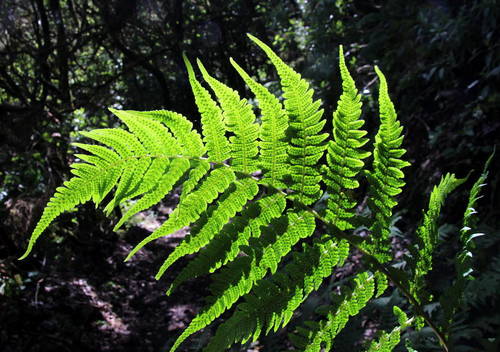


Dryopteris Oligodonta
dryopteris oligodonta
Dryopteris oligodonta, commonly known as the Canary Island wood fern, is a majestic and robust fern endemic to the unique Macaronesian archipelago. It is a defining feature of the humid laurel forests (laurisilva) and fayal-brezal woodlands of the Canary Islands, where it thrives in the deeply shaded, moist environments of volcanic ravines. This ancient plant species acts as a living link to the tertiary flora that once dominated the Mediterranean basin before the last ice age. Growing from a sturdy, creeping rhizome, this fern produces spectacular arches of lush green fronds that can reach up to two meters in height. It plays a vital ecological role in its native habitat, capturing moisture from the passing trade-wind clouds and providing shelter for a multitude of forest floor invertebrates.
Lebensraum: Found in humid, deep volcanic ravines and under the dense evergreen canopy of Macaronesian laurel forests.
This large, evergreen fern features bipinnate to tripinnate fronds that are broad, triangular, and bright to deep green. The fronds can reach lengths of 100 to 200 centimeters. A key identification feature is the dense covering of golden-brown, paper-like scales along the petiole and the central stalk. On the undersides of mature pinnules, dual rows of circular spore-producing sori can be seen, each protected by a distinct kidney-shaped membrane called an indusium.
Kategorie
PflanzenSeltenheit
Common
Gefahr
1/5 · Sehr gering
Snaps
Mach den ersten Snap!
Dryopteris oligodonta is a Tertiary relic, meaning it belongs to a plant lineage that has survived largely unchanged for millions of years.
Some individual fronds can grow so large that they sweep the forest floor, acting as natural traps for falling organic debris which decomposes and feeds the fern.
The dense, golden-brown scales covering its stalks act like a sponge, trapping humidity and creating a tiny micro-habitat for microscopic organisms right on the plant.
Uses a specialized ring of cells around its sporangia that bends and snaps with moisture changes to forcefully catapult spores into the wind.
Rhizomes and stems are densely covered in golden-brown scales that help retain moisture and protect the delicate growing tips from herbivores.
Possesses highly efficient chloroplast arrangements that allow the plant to harvest low-intensity sunlight filtering through dense forest canopies.
As a photosynthetic plant, it generates its own energy from sunlight, water, and carbon dioxide, while absorbing essential minerals from the moist forest soil.
Laurus novocanariensis
Grows under the protective canopy and humid microclimate created by this dominant forest tree.
Canariella canariensis
Endemic land snails feed on the decomposing fallen fronds of the fern on the humid forest floor.
Für dieses Objekt sind noch keine Merkmal-Badges vergeben.
Noch keine Alternativnamen vorhanden.
Sammlungen für dieses Objekt erscheinen hier, wenn weitere Themen hinzugefügt werden.
Gefahr
1/5 · Sehr gering
Noch keine besonderen Sicherheitshinweise.
Der einfachste Weg, Dryopteris Oligodonta zu bestimmen, ist die Verwendung der Naturführer-App Snappit.
100-200 cm
10-50 Jahre
As a photosynthetic plant, it generates its own energy from sunlight, water, and carbon dioxide, while absorbing essential minerals from the moist forest soil.
Found in humid, deep volcanic ravines and under the dense evergreen canopy of Macaronesian laurel forests.
Photosynthesis
Zoome hinein, um Cluster aufzulösen und zu sehen, wo dieses Objekt fotografiert wurde.
Neueste Snaps erscheinen hier, wenn neue Beobachtungen hinzukommen.













_Hibiscus_moscheutos_-_Red_swamp_rose-mallow_flower_-_Les_Martels%2C_Giroussens_Tarn.jpg&width=800)


