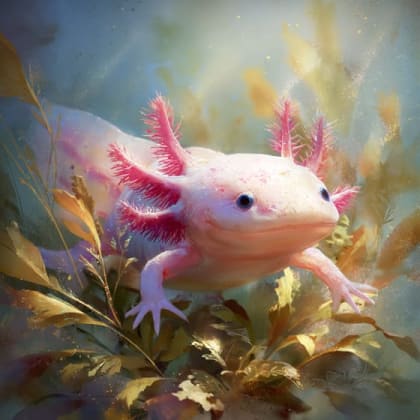
Dusky Salamanders
Desmognathus
Dusky Salamanders are small, slimy creatures that love to live in cool, wet places. They have smooth skin and can be found hiding under rocks or leaves in the forest.
Lebensraum: Forests
The Dusky Salamanders are typically brown to grayish-brown, often with a lighter stripe down their back. They have a stout body, robust limbs, and a distinctive keel-like tail that is compressed from side to side, making them visually distinct.
Kategorie
AmphibienSeltenheit
Common
Gefahr
1/5 · Sehr gering
Snaps
Mach den ersten Snap!
Female Dusky Salamanders carefully guard their clutch of eggs for many weeks until they hatch.
Some Dusky Salamanders can live in very cold mountain streams, even under sheets of ice!
Their eyes are fixed in place, meaning they must move their whole head to look around!
Unlike most salamanders, the larvae of some Dusky species stay entirely in the water.
Dusky Salamanders can breathe through their moist skin and mouth lining because they lack lungs as adults, helping them absorb oxygen.
Dusky Salamanders can drop their tail if a predator grabs it, allowing them to escape danger and grow a new one later.
Dusky Salamanders have a keeled, flattened tail that helps them powerfully propel themselves through fast-moving water.
Dusky Salamanders have strong, flexible toes that help them climb and cling to slippery rocks and stream banks.
These small hunters use keen senses to snap up tiny insects and other small creatures!
Altersunterschiede: Larvae eat microscopic aquatic invertebrates, while adults consume larger terrestrial and semi-aquatic prey.
Thamnophis sirtalis
A common predator in their North American habitat.
Sorex cinereus
Small mammals sometimes prey on these salamanders.
Formica fusca
Consumes various small ants found in moist habitat.
Lumbricus terrestris
Feeds on small earthworms found in damp soil.
Einzelgänger leben den größten Teil ihres Lebens allein und interagieren mit Artgenossen nur zur Paarung oder zur Aufzucht der Jungen.
Dieses Merkmal kennzeichnet Organismen, deren Nahrung hauptsächlich aus Insekten und anderen kleinen Wirbellosen besteht.
Waldlebensräume sind terrestrische Lebensräume, die von dichtem Baumbestand dominiert werden und eine große Vielfalt an Pflanzen- und Tierarten beherbergen.
Nachtaktive Tiere sind hauptsächlich in den Nachtstunden aktiv und ruhen oder schlafen normalerweise tagsüber.
Noch keine Alternativnamen vorhanden.
Gefahr
1/5 · Sehr gering
Always watch where you step in the forest to protect these little creatures and yourself.
7-15 cm
0.003-0.02 kg
5-10 Jahre
0.2 km/h
These small hunters use keen senses to snap up tiny insects and other small creatures!
Forests
Ambush
10-30
Zoome hinein, um Cluster aufzulösen und zu sehen, wo dieses Objekt fotografiert wurde.
Neueste Snaps erscheinen hier, wenn neue Beobachtungen hinzukommen.