

Dwarf Paintbrush
castilleja nana
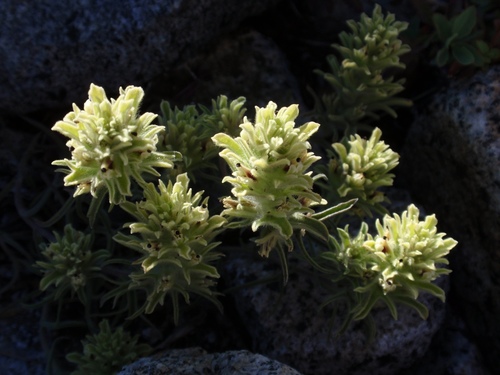
Castilleja nana, commonly known as the Dwarf Paintbrush, is a resilient and fascinating alpine wildflower that thrives in harsh, high-elevation environments. Unlike its fiery red cousins, this diminutive plant often displays muted tones of pale yellow, cream, or greenish-purple, blending subtly into the rocky landscapes it calls home. What makes the Dwarf Paintbrush truly remarkable is its hemiparasitic lifestyle; while it is perfectly capable of photosynthesizing, it supplements its nutrient and water intake by tapping into the root systems of neighboring host plants. This dual-survival strategy allows it to flourish in the nutrient-poor, frozen soils of subalpine and alpine zones, making it a rugged survivor of extreme mountain climates.
Lebensraum: Found primarily in dry, rocky alpine and subalpine meadows, windswept ridges, and talus slopes at high elevations.
The Dwarf Paintbrush is a small, low-growing herbaceous plant that rarely exceeds 15 centimeters in height. Its short stems and lance-shaped leaves are typically covered in fine, sticky hairs, giving the plant a somewhat grayish-green, fuzzy appearance. The true flowers are inconspicuous and tubular, remaining hidden within showy, leaf-like bracts that cluster densely at the top of the stems. These bracts are usually pale yellow to creamy white, and are frequently tipped or tinged with shades of dusty purple, dull pink, or brownish-green.
Kategorie
PflanzenSeltenheit
Common
Gefahr
1/5 · Sehr gering
Snaps
Mach den ersten Snap!
Because it relies on host plants for survival, transplanting a Dwarf Paintbrush into a garden usually fails unless its specific host plant is moved with it.
The 'flower' petals of the Dwarf Paintbrush are actually modified leaves called bracts; the true flowers are small, green, and hidden inside.
The species name 'nana' comes from the Latin word for 'dwarf', perfectly describing its tiny stature which keeps it out of the harsh, freezing winds of alpine ridges.
Uses specialized root structures called haustoria to penetrate the roots of nearby host plants, extracting water and essential nutrients.
Its low-growing, compact form and hairy stems protect it from freezing winds, intense UV radiation, and severe desiccation in high-mountain habitats.
Relies on brightly or uniquely colored modified leaves (bracts) rather than actual flower petals to attract high-altitude pollinators like bumblebees.
As a hemiparasite, it produces its own energy through photosynthesis but relies heavily on stealing water and minerals from the roots of neighboring host plants.
Altersunterschiede: Seedlings must quickly establish a connection with a host plant root to survive past their initial growth phase.
Artemisia tridentata subsp. vaseyana
Parasitizes the roots of alpine sagebrush to extract vital water and nutrients.
Bombus vosnesenskii
Provides nectar to high-altitude insects, which in turn help pollinate the plant.
Festuca brachyphylla
Frequently uses deep-rooted alpine bunchgrasses as an alternative host plant.
Für dieses Objekt sind noch keine Merkmal-Badges vergeben.
Noch keine Alternativnamen vorhanden.
Sammlungen für dieses Objekt erscheinen hier, wenn weitere Themen hinzugefügt werden.
Gefahr
1/5 · Sehr gering
Noch keine besonderen Sicherheitshinweise.
Der einfachste Weg, Dwarf Paintbrush zu bestimmen, ist die Verwendung der Naturführer-App Snappit.
5-15 cm
2-10 Jahre
As a hemiparasite, it produces its own energy through photosynthesis but relies heavily on stealing water and minerals from the roots of neighboring host plants.
Found primarily in dry, rocky alpine and subalpine meadows, windswept ridges, and talus slopes at high elevations.
Parasitism
Zoome hinein, um Cluster aufzulösen und zu sehen, wo dieses Objekt fotografiert wurde.
Neueste Snaps erscheinen hier, wenn neue Beobachtungen hinzukommen.









.jpg&width=800)








.jpg&width=800)

