

Eastern American Jack-O'-Lantern
omphalotus illudens
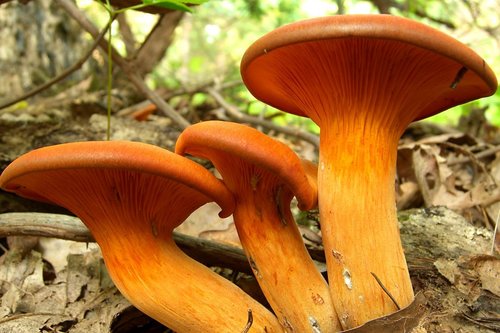
The Eastern American Jack-O'-Lantern (Omphalotus illudens) is a striking, pumpkin-orange mushroom that brings a touch of magic to the forest floor. Famous for its eerie, bioluminescent gills that glow with a faint green light in total darkness, this fungus looks like something straight out of a fairy tale. Usually found emerging in large, vibrant clusters at the base of hardwood trees, it is a master of disguise, frequently confusing novice foragers who mistake it for the delicious golden chanterelle. However, the Jack-O'-Lantern holds a toxic secret: consuming it leads to severe gastrointestinal distress due to a chemical called illudin S. Beyond its deceptive appearance and glowing party trick, this species plays a vital ecological role. As a saprobic fungus, it works tirelessly behind the scenes to break down tough wood fibers, recycling essential nutrients back into the forest ecosystem.
Lebensraum: Found in dense deciduous forests, usually growing in large clusters on decaying hardwood stumps, buried roots, or fallen logs, particularly oak.
This mushroom features a smooth, bright orange to yellowish-orange cap that ranges from 5 to 20 centimeters in diameter, often becoming depressed or funnel-shaped in the center as it matures. Its sharp, narrow gills are true gills that run down the length of its slender, tapering stem (a feature known as decurrent gills). They grow in dense, overlapping clusters, which is a key distinguishing feature from chanterelles, and the spore print it leaves behind is creamy white to pale yellow.
Kategorie
PilzeSeltenheit
Common
Gefahr
1/5 · Sehr gering
Snaps
Mach den ersten Snap!
Because the mushroom often grows on buried, decaying roots, it can appear to be sprouting directly from the soil, adding to the confusion with chanterelles.
Its vibrant orange color and seasonal appearance around October earned it the 'Jack-O'-Lantern' moniker long before the science of its glow was fully understood.
The green glow of its gills peaks when the mushroom is rapidly growing and releasing spores, acting as a potential beacon to attract nocturnal insects that help disperse the spores.
The toxic compound in the mushroom, illudin S, is actually being actively researched by scientists for potential anti-cancer properties.
The gills of the mushroom emit a faint, continuous green glow in the dark, driven by a chemical reaction involving the enzyme luciferase and luciferin.
Produces a toxic compound called illudin S, which causes severe cramps and vomiting, deterring many animals and humans from eating it.
Secretes powerful enzymes capable of breaking down tough lignin and cellulose in dead wood, turning it into rich soil over time.
As a saprobic fungus, it obtains its nutrients entirely by breaking down and absorbing dead organic matter from hardwood trees.
Quercus alba
Breaks down the dead wood and buried roots of this tree species.
Mycetophila fungorum
Lays its eggs in the fruiting body, and the emerging larvae feed on the mushroom tissue.
Limax maximus
Feeds on the decomposing mushroom flesh, seemingly immune to its toxins.
Für dieses Objekt sind noch keine Merkmal-Badges vergeben.
Noch keine Alternativnamen vorhanden.
Sammlungen für dieses Objekt erscheinen hier, wenn weitere Themen hinzugefügt werden.
Gefahr
1/5 · Sehr gering
Noch keine besonderen Sicherheitshinweise.
Der einfachste Weg, Eastern American Jack-O'-Lantern zu bestimmen, ist die Verwendung der Naturführer-App Snappit.
5-20 cm
0.02-0.2 kg
As a saprobic fungus, it obtains its nutrients entirely by breaking down and absorbing dead organic matter from hardwood trees.
Found in dense deciduous forests, usually growing in large clusters on decaying hardwood stumps, buried roots, or fallen logs, particularly oak.
Saprophytic Absorption
Zoome hinein, um Cluster aufzulösen und zu sehen, wo dieses Objekt fotografiert wurde.
Neueste Snaps erscheinen hier, wenn neue Beobachtungen hinzukommen.