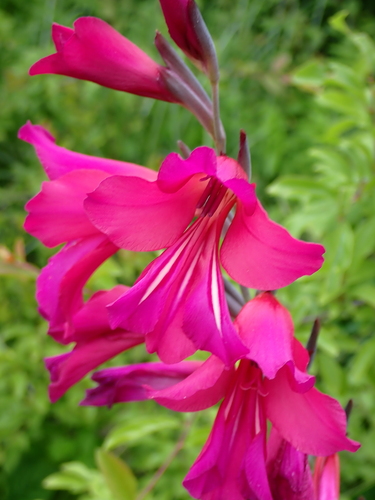


Eastern Gladiolus
gladiolus communis
The Eastern Gladiolus (Gladiolus communis) is a striking perennial herb known for its elegant, sword-like leaves and vibrant spikes of bright pinkish-purple flowers. Native to the Mediterranean region, this hardy geophyte has captured the hearts of gardeners and nature enthusiasts alike. It emerges each spring from an underground corm, rising gracefully to decorate meadows, open woodlands, and rocky hillsides with its stunning, asymmetric blooms. Beyond its ornamental value, the Eastern Gladiolus plays a vital role in its native ecosystem by providing an early-summer nectar source for various long-tongued insects, including bees and butterflies.
Lebensraum: Found in Mediterranean-style open woodlands, grassy meadows, rocky hillsides, and coastal scrub, often thriving in well-drained, sunny locations.
This species typically reaches a height of 50 to 100 cm, featuring erect, sword-shaped leaves that are medium green and form a fan-like base. The flowers are arranged in a unilateral spike, containing 10 to 20 individual blooms. Each flower is trumpet-shaped, measuring about 3 to 4 cm long, and displays a rich magenta, pink, or purplish-red hue. The three lower petals often feature a white or pale streak down the center, outlined in a darker purple, which serves as a nectar guide for pollinators.
Kategorie
PflanzenSeltenheit
Common
Gefahr
1/5 · Sehr gering
Snaps
Mach den ersten Snap!
In ancient Roman times, gladiators were associated with this flower, and some wore the plant's corms as amulets for protection in the arena.
The name 'Gladiolus' comes from the Latin word 'gladius', meaning sword, which directly references the plant's sharp, sword-shaped foliage.
Unlike the vast majority of Gladiolus species which originate in South Africa, the Eastern Gladiolus is one of the few species native to Europe.
Stores nutrients and water in an underground corm, allowing the plant to survive harsh, dry Mediterranean summers and cold winters.
Features prominent white streaks on its lower petals that act as visual signs to guide pollinating insects directly to the nectar.
Possesses vertical, sword-like leaves that efficiently channel rainwater down to the root system while minimizing sun exposure during the day.
As a photosynthetic plant, the Eastern Gladiolus produces its own energy using sunlight, water, carbon dioxide, and essential soil minerals.
Apis mellifera
Provides nectar and pollen to this insect, which acts as a primary pollinator.
Thrips simplex
Feeds on the sap of leaves and flowers, causing silvering, stunting, and damage to the plant.
Für dieses Objekt sind noch keine Merkmal-Badges vergeben.
Noch keine Alternativnamen vorhanden.
Sammlungen für dieses Objekt erscheinen hier, wenn weitere Themen hinzugefügt werden.
Gefahr
1/5 · Sehr gering
Noch keine besonderen Sicherheitshinweise.
Der einfachste Weg, Eastern Gladiolus zu bestimmen, ist die Verwendung der Naturführer-App Snappit.
50-100 cm
0.05-0.2 kg
5-15 Jahre
As a photosynthetic plant, the Eastern Gladiolus produces its own energy using sunlight, water, carbon dioxide, and essential soil minerals.
Found in Mediterranean-style open woodlands, grassy meadows, rocky hillsides, and coastal scrub, often thriving in well-drained, sunny locations.
Zoome hinein, um Cluster aufzulösen und zu sehen, wo dieses Objekt fotografiert wurde.
Neueste Snaps erscheinen hier, wenn neue Beobachtungen hinzukommen.