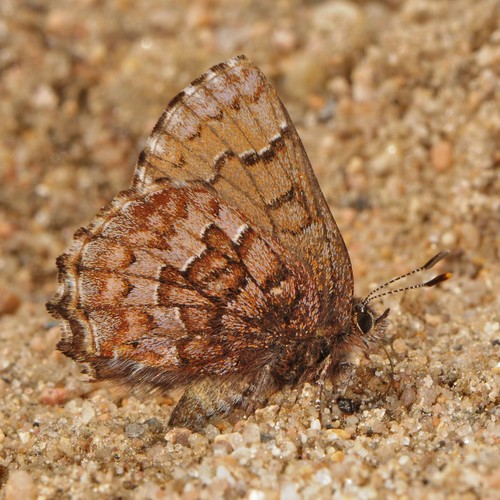


Eastern Pine Elfin
callophrys niphon
The Eastern Pine Elfin (Callophrys niphon) is a charming, small butterfly that heralds the arrival of spring in the pine forests of eastern North America. Belonging to the gossamer-winged butterfly family, this species is highly specialized, spending its entire life cycle in close association with pine trees. It is uniquely adapted to survive cold early-spring temperatures, often emerging when snow is still melting on the ground. Its brief adult flight period makes it a highly anticipated sight for butterfly enthusiasts each year. Because they spend much of their time high in the pine canopy, spotting one at ground level as it searches for moisture or early nectar is always a rewarding experience. Their quiet, fluttering flight and remarkable ability to blend into their surroundings make them a fascinating subject for nature lovers and researchers alike.
Lebensraum: Found in pine-oak barrens, pine forests, pulpwood plantations, and sandy forest edges containing young pine trees.
The Eastern Pine Elfin is a small butterfly with a wingspan of 2 to 3 centimeters. When resting, it holds its wings tightly closed, revealing a highly intricate underside pattern of bands and zig-zag lines in shades of rich brown, grey, and rusty red, outlined with a frosty grayish-white margin. The upperside of the wings, which is rarely seen except in flight, is a uniform, warm bronze-brown. It lacks tail-like projections on its hindwings, distinguishing it from some related hairstreak species, and possesses characteristic banded grey-and-white antennae.
Kategorie
InsektenSeltenheit
Common
Gefahr
1/5 · Sehr gering
Snaps
Mach den ersten Snap!
The caterpillars are beautifully striped with green and white, allowing them to blend in seamlessly with the pine needles they eat.
They are among the very first butterflies to emerge in the spring, often active when air temperatures are still quite cool.
When they land, they almost always close their wings immediately, relying entirely on their bark-like camouflage to hide from predators.
The intricate brown and grey patterning on the underside of its wings perfectly mimics the texture of pine bark and dead needles, rendering the butterfly invisible when resting.
The caterpillars possess specialized glands that secrete sweet liquids, attracting ants that protect the larvae from predators in a mutualistic relationship.
This species spends the harsh winter months as a pupa on the forest floor, waiting for the precise warmth of early spring to emerge.
Caterpillars feed exclusively on the tender needles of various pine species, while adults forage for nectar from early spring flowers, tree sap, and moisture from damp soil.
Altersunterschiede: Caterpillars feed on pine needles, whereas adults drink plant nectar and sap.
Pinus strobus
Larvae feed on the young, tender spring needles of this host tree.
Pinus rigida
Larvae feed on the needles of this tree in pine barrens habitats.
Formica exsectoides
Ants protect the caterpillars from predators while consuming their sugary secretions.
Für dieses Objekt sind noch keine Merkmal-Badges vergeben.
Noch keine Alternativnamen vorhanden.
Sammlungen für dieses Objekt erscheinen hier, wenn weitere Themen hinzugefügt werden.
Gefahr
1/5 · Sehr gering
Noch keine besonderen Sicherheitshinweise.
Der einfachste Weg, Eastern Pine Elfin zu bestimmen, ist die Verwendung der Naturführer-App Snappit.
1-2 cm
2-3 cm
0.0001-0.0003 kg
1 Jahre
12 km/h
Caterpillars feed exclusively on the tender needles of various pine species, while adults forage for nectar from early spring flowers, tree sap, and moisture from damp soil.
Found in pine-oak barrens, pine forests, pulpwood plantations, and sandy forest edges containing young pine trees.
Zoome hinein, um Cluster aufzulösen und zu sehen, wo dieses Objekt fotografiert wurde.
Neueste Snaps erscheinen hier, wenn neue Beobachtungen hinzukommen.














