

Erodium Paularense
erodium paularense
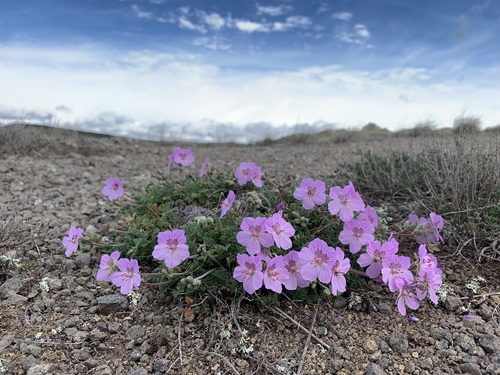
Erodium paularense, commonly known as the heron's bill of El Paular, is an extremely rare and critically endangered perennial plant endemic to a few highly specific locations in central Spain. Belonging to the Geraniaceae family, this resilient little plant is famous for its striking pinkish-white flowers decorated with intricate, dark purple veining on the upper petals. First discovered in the Alto Valle del Lozoya near the El Paular monastery, it is a biological treasure specialized in surviving the harsh, dry conditions of gypsum and limestone outcrops. Despite its delicate appearance, this plant has adapted to withstand extreme temperature fluctuations and poor soil quality, securing its niche where few other plants can compete.
Lebensraum: Found growing exclusively on sunny, rocky limestone and gypsum-rich cliffs and outcrops in the semi-arid Mediterranean environments of central Spain.
This low-growing, cushion-forming perennial subshrub typically reaches a height of 5 to 15 centimeters. It features a woody base with greyish-green, deeply lobed leaves covered in soft, velvety hairs that help retain moisture. Its most identifying feature is the umbel-like cluster of flowers, which have five asymmetric petals. The two upper petals are smaller, bearing a prominent dark purple or black spot near the base with dark branching veins, while the three lower petals are slightly larger, unspotted, and pale pink to white.
Kategorie
PflanzenSeltenheit
Common
Gefahr
1/5 · Sehr gering
Snaps
Mach den ersten Snap!
It is a true gypsophile, meaning it has evolved to thrive in soils with high concentrations of calcium and gypsum that would kill most other plant species.
It is named 'paularense' after the Santa María de El Paular monastery in Madrid, near where the species was first discovered and described.
The plant's seeds act like miniature drills; when they touch damp soil, changes in humidity cause the tail-like awn to twist and push the seed deep into the earth.
The plant is specially adapted to thrive in nutrient-poor, calcium-sulfate-rich gypsum soils that are toxic to most other plant species.
Its seeds feature a long, spirally twisted awn that coils and uncoils with changes in humidity, physically drilling the seed into the ground to ensure successful germination.
Its leaves are covered in dense, fine hairs that trap moisture, reduce wind desiccation, and reflect intense solar radiation.
As a photosynthetic plant, it produces its own energy using sunlight, carbon dioxide, and water, supplemented by minerals absorbed from gypsum and limestone soils.
Apis mellifera
Provides nectar and pollen to bees, which assist in cross-pollinating the flowers.
Oryctolagus cuniculus
Rabbits feed on the foliage and stems, posing a grazing threat to localized populations.
Gypsophila struthium
Co-occurs in the specialized gypsophilous scrublands, competing for limited soil nutrients.
Für dieses Objekt sind noch keine Merkmal-Badges vergeben.
Sammlungen für dieses Objekt erscheinen hier, wenn weitere Themen hinzugefügt werden.
Gefahr
1/5 · Sehr gering
Noch keine besonderen Sicherheitshinweise.
Der einfachste Weg, Erodium Paularense zu bestimmen, ist die Verwendung der Naturführer-App Snappit.
5-15 cm
5-15 Jahre
As a photosynthetic plant, it produces its own energy using sunlight, carbon dioxide, and water, supplemented by minerals absorbed from gypsum and limestone soils.
Found growing exclusively on sunny, rocky limestone and gypsum-rich cliffs and outcrops in the semi-arid Mediterranean environments of central Spain.
5+
14-30 Tage
Zoome hinein, um Cluster aufzulösen und zu sehen, wo dieses Objekt fotografiert wurde.
Neueste Snaps erscheinen hier, wenn neue Beobachtungen hinzukommen.