

Erodius
erodius
Erodius beetles are fascinating inhabitants of arid and semi-arid landscapes, exemplifying resilience in some of the planet's harshest environments. These darkling beetles are characterized by their robust, often heavily sclerotized exoskeletons, which serve as crucial armor against predators and environmental stressors like desiccation. Primarily detritivores, Erodius species play an essential ecological role as decomposers, breaking down dead plant material and contributing to nutrient cycling in their often sparse habitats. Their adaptations to dry conditions, including efficient water conservation mechanisms, make them an intriguing subject for study and a common sight for observant naturalists in their specific niches.
Lebensraum: Erodius beetles are typically found in arid and semi-arid regions, including deserts, sandy coastal dunes, and dry scrublands, often burrowing in sand or sheltering under rocks and detritus.
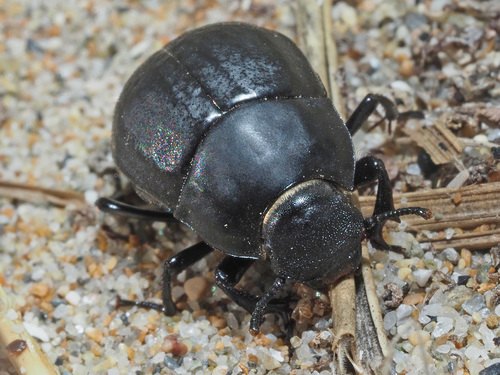
Erodius beetles typically exhibit a stocky, oval, or somewhat flattened body shape, ranging from approximately 1.5 to 4 centimeters in length. Their coloration is usually a drab, matte black, dark brown, or gray, providing excellent camouflage against sandy or rocky substrates. The elytra (wing covers) are fused, rendering them flightless, and often feature a rough, granular, or ridged texture, contributing to their "ironclad" appearance. They possess relatively short, sturdy legs adapted for scuttling across the ground and navigating loose sand, along with short, segmented antennae.
Kategorie
InsektenSeltenheit
Common
Gefahr
1/5 · Sehr gering
Snaps
Mach den ersten Snap!
Many Erodius species are entirely flightless, with their elytra fused into a solid protective shield, earning them the nickname "ironclad beetles."
Some Erodius beetles exhibit a unique "headstand" behavior during foggy conditions, allowing condensed water droplets to trickle down their backs to their mouths for hydration.
Their tough exoskeletons and defensive chemical secretions help them deter a variety of predators in their arid habitats.
These beetles are crucial detritivores in desert ecosystems, contributing significantly to breaking down dead organic matter and recycling nutrients in nutrient-poor soils.
The thick, heavily sclerotized cuticle provides excellent protection against predators and reduces water loss in dry environments, acting as a natural armor.
Certain species can perform a "headstand" behavior, allowing condensed fog droplets to collect on their bodies and channel water towards their mouthparts, a crucial adaptation in arid zones.
Like many darkling beetles, Erodius can secrete noxious chemicals from glands, deterring potential predators with foul-smelling or irritating compounds.
Erodius beetles primarily feed on decaying organic matter, playing a vital role in nutrient decomposition in arid ecosystems. They consume various forms of dead plant material.
Acanthodactylus erythrurus
A common predator of Erodius beetles in desert environments.
Various genera
Larvae and adults often feed on subterranean fungi and decaying plant roots.
Gerbillus gerbillus
The beetle is preyed upon by various desert-dwelling rodents.
Atriplex spp.
Larval stages may feed on the roots of various desert plants.
Für dieses Objekt sind noch keine Merkmal-Badges vergeben.
Noch keine Alternativnamen vorhanden.
Sammlungen für dieses Objekt erscheinen hier, wenn weitere Themen hinzugefügt werden.
Gefahr
1/5 · Sehr gering
Noch keine besonderen Sicherheitshinweise.
Der einfachste Weg, Erodius zu bestimmen, ist die Verwendung der Naturführer-App Snappit.
1-4 cm
0.001-0.006 kg
1-3 Jahre
Erodius beetles primarily feed on decaying organic matter, playing a vital role in nutrient decomposition in arid ecosystems. They consume various forms of dead plant material.
Erodius beetles are typically found in arid and semi-arid regions, including deserts, sandy coastal dunes, and dry scrublands, often burrowing in sand or sheltering under rocks and detritus.
Foraging
30-150
Zoome hinein, um Cluster aufzulösen und zu sehen, wo dieses Objekt fotografiert wurde.
Neueste Snaps erscheinen hier, wenn neue Beobachtungen hinzukommen.




_(14693746782).jpg&width=800)












