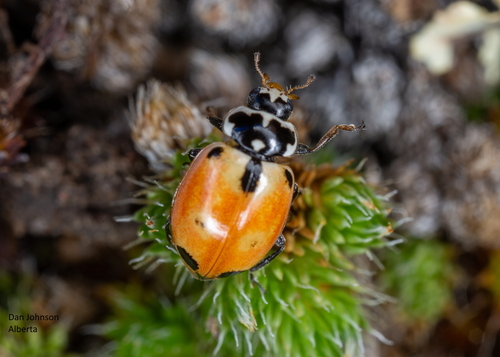


Expurgate Lady Beetle
hippodamia expurgata
The Expurgate Lady Beetle (Hippodamia expurgata) is a beneficial predatory beetle native to western North America. Active primarily during the spring and summer months, this insect plays an invaluable ecological role as a natural pest control agent. Both adults and larvae are voracious predators of soft-bodied garden pests, especially aphids, making them highly welcomed by farmers and gardeners alike.
Lebensraum: Typically found in open grasslands, agricultural fields, mountain meadows, and riparian shrublands where host plants and prey are abundant.
This small beetle ranges from 4.0 to 5.5 mm in length and exhibits an elongated, oval body. Its elytra (wing covers) are orange to reddish-yellow, decorated with several small, variable black spots that can occasionally merge or be entirely absent. Its distinct black pronotum features thin white margins and two prominent, pale, converging dash marks in the center, which helps distinguish it from other local lady beetle species.
Kategorie
InsektenSeltenheit
Common
Gefahr
1/5 · Sehr gering
Snaps
Mach den ersten Snap!
An individual adult Expurgate Lady Beetle can devour up to 50 aphids in a single day, while its voracious larvae can eat hundreds over their development cycle.
During cold weather, they hibernate in tight clusters to pool their body heat, sometimes containing hundreds of individuals in a single sheltered spot.
The convergent pale lines on their black pronotum serve as a diagnostic visual marker that allows entomologists to quickly identify them in the field.
When threatened, it can exude a foul-smelling, bitter yellow fluid from its leg joints to deter predators like birds and ants.
Uses highly sensitive olfactory receptors on its antennae to locate volatile chemicals released by plants under aphid attack.
Undergoes diapause during winter, gathering in large clusters under logs, rocks, or pine needles to conserve heat and survive freezing temperatures.
Both larvae and adults feed extensively on aphids, scale insects, mites, and other soft-bodied agricultural pests.
Altersunterschiede: While both stages are insectivorous, adults will occasionally feed on pollen and nectar when prey densities are low.
Acyrthosiphon pisum
Actively preys on aphid populations, providing a vital agricultural bio-control service.
Turdus migratorius
Forages in vegetation and opportunistically preys upon small beetles including ladybugs.
Chrysoperla carnea
Competes directly for aphid resources in agricultural fields and native grasslands.
Für dieses Objekt sind noch keine Merkmal-Badges vergeben.
Noch keine Alternativnamen vorhanden.
Sammlungen für dieses Objekt erscheinen hier, wenn weitere Themen hinzugefügt werden.
Gefahr
1/5 · Sehr gering
Noch keine besonderen Sicherheitshinweise.
Der einfachste Weg, Expurgate Lady Beetle zu bestimmen, ist die Verwendung der Naturführer-App Snappit.
0 cm
0-1 cm
0.00001-0.00003 kg
1 Jahre
5 km/h
Both larvae and adults feed extensively on aphids, scale insects, mites, and other soft-bodied agricultural pests.
Typically found in open grasslands, agricultural fields, mountain meadows, and riparian shrublands where host plants and prey are abundant.
Zoome hinein, um Cluster aufzulösen und zu sehen, wo dieses Objekt fotografiert wurde.
Neueste Snaps erscheinen hier, wenn neue Beobachtungen hinzukommen.




.jpg&width=800)












