

False Meadow Saffron
colchicum montanum
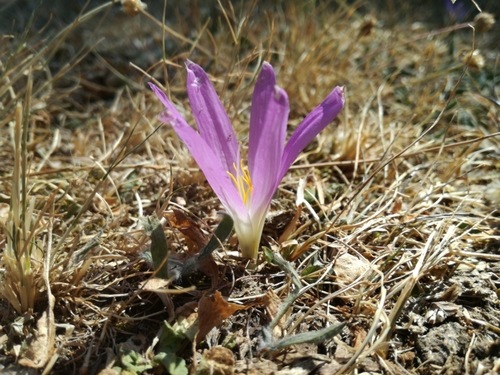
The False Meadow Saffron (Colchicum montanum), also historically classified as Merendera montana, is a charming, low-growing perennial herb native to the mountainous regions of the Iberian Peninsula and the Pyrenees. This resilient wildflower is celebrated for its striking, star-shaped blossoms that emerge in late summer and autumn, painting subalpine grasslands and rocky meadows in delicate shades of lilac, pink, or white. Often appearing before its leaves develop, this plant presents a mesmerizing sight of bare-stemmed flowers pushing through the sun-baked earth. Despite its delicate and inviting appearance, the False Meadow Saffron is a powerhouse of chemical defense. It belongs to the Colchicaceae family, meaning it is packed with colchicine, a potent toxin that protects the plant from hungry herbivores. For hikers and nature enthusiasts exploring the high altitudes of Spain, Portugal, and southern France, spotting these low-lying blooms is a quintessential highlight of the changing seasons.
Lebensraum: Typically found in sun-exposed montane pastures, rocky meadows, and clearings within scrublands at elevations of 500 to 2,500 meters.
Colchicum montanum is a dwarf bulbous plant reaching only 5 to 15 cm in height. It features distinct star-shaped flowers with six narrow, lanceolate tepals that range in color from soft pale pink and lilac to pure white. Unlike true crocuses, which have three stamens, the False Meadow Saffron possesses six prominent stamens tipped with yellow or brown anthers. The flowers rise directly from the ground on slender, pale tubes without a green stem. After the flowering phase ends, three or four channelled, linear, dark-green leaves emerge in late winter or early spring, growing alongside a capsule-like fruit that matures at ground level.
Kategorie
PflanzenSeltenheit
Common
Gefahr
1/5 · Sehr gering
Snaps
Mach den ersten Snap!
Every part of this plant contains colchicine, a highly toxic compound that can be fatal if ingested, but is also extracted for pharmaceutical use to treat gout.
Its seeds have an evolutionary partnership with ants, which carry them underground to feed on a sugary attachment, planting the seeds in safe, nutrient-rich soil.
Unlike many other autumn-flowering bulbs, the False Meadow Saffron produces its flowers directly from the ground before its leaves emerge, a phenomenon known as hysteranthy.
Blooms in late summer and autumn when most other plants are dormant, taking advantage of reduced competition for pollinators.
Produces colchicine, a highly toxic alkaloid that deters grazing livestock and insect pests.
Attaches a sweet, nutrient-rich lipid structure called an elaiosome to its seeds, enticing ants to carry and disperse them.
A photosynthetic autotroph that manufactures its own organic compounds using sunlight, water, carbon dioxide, and essential soil minerals.
Apis mellifera
Polinated by honey bees collecting late-season nectar and pollen.
Messor barbarus
Ants carry the seeds to their nests to feed on the sweet elaiosome, aiding seed dispersal.
Uromyces colchici
A specialized rust fungus that parasitizes the foliage of Colchicum species.
Für dieses Objekt sind noch keine Merkmal-Badges vergeben.
Noch keine Alternativnamen vorhanden.
Sammlungen für dieses Objekt erscheinen hier, wenn weitere Themen hinzugefügt werden.
Gefahr
1/5 · Sehr gering
Noch keine besonderen Sicherheitshinweise.
Der einfachste Weg, False Meadow Saffron zu bestimmen, ist die Verwendung der Naturführer-App Snappit.
5-15 cm
5-15 Jahre
A photosynthetic autotroph that manufactures its own organic compounds using sunlight, water, carbon dioxide, and essential soil minerals.
Typically found in sun-exposed montane pastures, rocky meadows, and clearings within scrublands at elevations of 500 to 2,500 meters.
Zoome hinein, um Cluster aufzulösen und zu sehen, wo dieses Objekt fotografiert wurde.
Neueste Snaps erscheinen hier, wenn neue Beobachtungen hinzukommen.