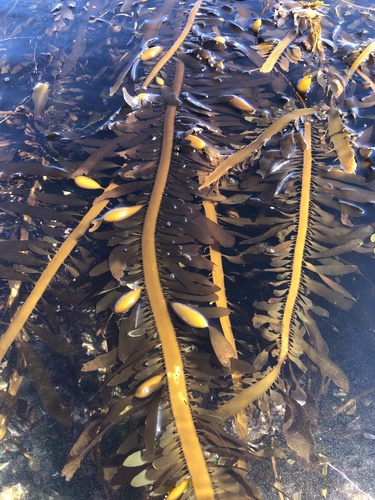


Feather Boa Kelp
egregia menziesii
Feather Boa Kelp (Egregia menziesii) is a striking and highly resilient species of kelp native to the rocky intertidal zones of the Pacific coast of North America. Renowned for its distinctive, strap-like fronds fringed with small, leaf-like blades and bulbous floats, this marine alga resembles a long, luxurious boa draped across the tide pools. It plays a critical ecological role, acting as a foundational species that constructs miniature underwater forests. These structures provide vital shelter, nursery grounds, and foraging territories for an incredibly diverse array of marine invertebrates, fish, and sea birds.
Lebensraum: Found in the lower intertidal and shallow subtidal zones along wave-swept rocky shores.
This large, dark brown to olive-green kelp is instantly recognizable by its long, flat central stipe which is densely bordered by small, strap-like branchlets and small, spherical or oval air bladders that help the plant float. The entire structure can reach impressive lengths of up to 15 meters. At the base, a robust, branch-like holdfast anchors the kelp firmly to rocks, allowing it to withstand the relentless battering of coastal waves.
Kategorie
AnimalSeltenheit
Common
Gefahr
1/5 · Sehr gering
Snaps
Mach den ersten Snap!
Native American tribes historically used the durable, strap-like stipes of the feather boa kelp to construct sturdy fishing lines.
The common name 'feather boa' comes from the kelp's striking resemblance to the fluffy fashion accessory when draped over coastal rocks at low tide.
The gas-filled pneumatocysts contain a mix of oxygen, nitrogen, and carbon monoxide, which keeps the heavy fronds buoyant in turbulent waters.
This species is incredibly fast-growing, capable of extending its fronds by several centimeters per day during the peak spring and summer growing seasons.
Utilizes a dense, branching root-like system that anchors the kelp securely to rocky substrates, preventing it from being swept away by powerful ocean waves.
Employs gas-filled bladders along its fronds to keep its photosynthesizing tissues afloat and oriented toward sunlight near the water's surface.
Possesses a highly durable, strap-like central stipe that can bend and stretch without snapping, absorbing the mechanical energy of turbulent waves.
As a photosynthetic marine alga, the Feather Boa Kelp generates its own energy from sunlight, carbon dioxide, and dissolved oceanic nutrients.
Strongylocentrotus purpuratus
Grazes directly on the kelp fronds, sometimes causing significant damage to the holdfast.
Pugettia producta
Clings to the flat stipes of the kelp, feeding on the blades and using the plant as camouflage.
Lottia pelta
A small marine snail that specializes in grazing on the microalgae growing on the surfaces of this kelp.
Für dieses Objekt sind noch keine Merkmal-Badges vergeben.
Noch keine Alternativnamen vorhanden.
Sammlungen für dieses Objekt erscheinen hier, wenn weitere Themen hinzugefügt werden.
Gefahr
1/5 · Sehr gering
Noch keine besonderen Sicherheitshinweise.
Der einfachste Weg, Feather Boa Kelp zu bestimmen, ist die Verwendung der Naturführer-App Snappit.
100-1500 cm
1-10 kg
1-3 Jahre
As a photosynthetic marine alga, the Feather Boa Kelp generates its own energy from sunlight, carbon dioxide, and dissolved oceanic nutrients.
Found in the lower intertidal and shallow subtidal zones along wave-swept rocky shores.
Photosynthesis
Zoome hinein, um Cluster aufzulösen und zu sehen, wo dieses Objekt fotografiert wurde.
Neueste Snaps erscheinen hier, wenn neue Beobachtungen hinzukommen.

California, US
Hier kann man sehen Seehund, Ochre Sea Star und Grasnelke.
Führer anzeigen →

California, US
Hier kann man sehen Sonnenstrahl-Anemone und Ochre Sea Star.
Führer anzeigen →

California, US
Hier kann man sehen Sonnenstrahl-Anemone und Gestreifte Uferkrabbe.
Führer anzeigen →



