

Fiddlewood
citharexylum caudatum
Fiddlewood (Citharexylum caudatum) is a beautiful, evergreen shrub or small tree native to the wet forests and coastal zones of the Caribbean, Central America, and Southern Florida. Highly regarded for its lush foliage and dramatic, drooping clusters of colorful berries, this resilient plant plays a vital ecological role by providing a consistent food source for local bird populations. Its name is thought to have originated from a French translation error, transforming 'bois fidèle' (meaning faithful or strong wood) into 'fiddlewood' over centuries of colloquial use.
Lebensraum: Found in wet forests, subtropical woodlands, and coastal thickets, often thriving in moist, well-drained soils under partial shade to full sun.
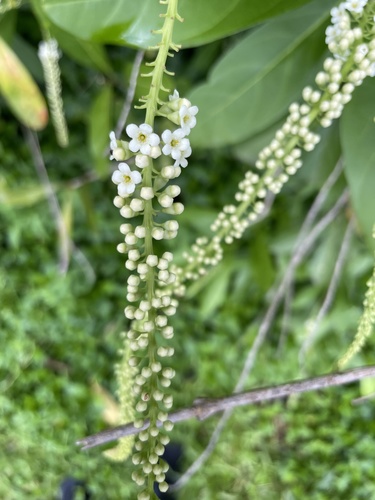
Fiddlewood is characterized by its glossy, elliptical green leaves that grow in opposite pairs along square-shaped young branches. It produces hanging spikes (racemes) of tiny, fragrant, white tubular flowers. These blossoms develop into small, round berries that transition through an eye-catching sequence of colors, maturing from green to bright yellow, then orange, and finally to a glossy, dark purplish-black, with multiple colors often visible on a single spike simultaneously. The plant typically grows between 2 to 12 meters in height with a dense, rounded canopy.
Kategorie
PflanzenSeltenheit
Common
Gefahr
1/5 · Sehr gering
Snaps
Mach den ersten Snap!
Despite the name, the wood is historically rarely used to make actual violins or fiddles, but is instead valued for fence posts.
It is sometimes called 'Juniper Berry' in local Caribbean dialects due to the appearance of its dark, dense fruit clusters.
The name 'Fiddlewood' is actually a linguistic mistranslation of 'bois fidèle', the French name meaning 'faithful wood', which referred to its toughness and utility.
Its berries ripen at different times on the same stalk, displaying a spectrum of bright colors to attract diverse bird species over an extended period.
The dense wood produces natural compounds that make it exceptionally durable and highly resistant to decay and insect damage.
It possesses a high tolerance for airborne sea salt, allowing it to thrive in windy coastal environments where other trees fail.
As a photosynthetic plant, Fiddlewood synthesizes its own energy from sunlight, water, and carbon dioxide while absorbing essential minerals through its root system.
Spindalis zena
The Western Spindalis feeds heavily on the ripe black berries and assists in dispersing the plant's seeds.
Apis mellifera
The Western Honey Bee visits the fragrant white flowers to collect nectar, acting as a key pollinator.
Coereba flaveola
The Bananaquit feeds on the sweet nectar of the tubular flowers.
Für dieses Objekt sind noch keine Merkmal-Badges vergeben.
Noch keine Alternativnamen vorhanden.
Sammlungen für dieses Objekt erscheinen hier, wenn weitere Themen hinzugefügt werden.
Gefahr
1/5 · Sehr gering
Noch keine besonderen Sicherheitshinweise.
Der einfachste Weg, Fiddlewood zu bestimmen, ist die Verwendung der Naturführer-App Snappit.
200-1200 cm
30-100 Jahre
As a photosynthetic plant, Fiddlewood synthesizes its own energy from sunlight, water, and carbon dioxide while absorbing essential minerals through its root system.
Found in wet forests, subtropical woodlands, and coastal thickets, often thriving in moist, well-drained soils under partial shade to full sun.
Zoome hinein, um Cluster aufzulösen und zu sehen, wo dieses Objekt fotografiert wurde.
Neueste Snaps erscheinen hier, wenn neue Beobachtungen hinzukommen.