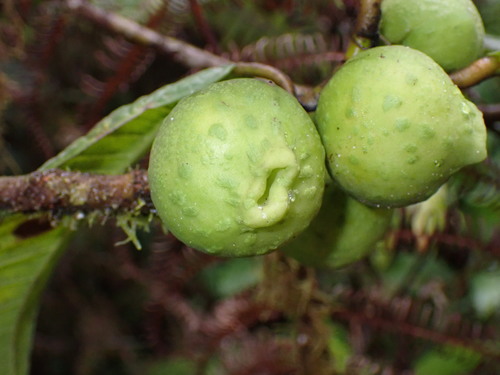


Figs
ficus
Figs, belonging to the genus Ficus, represent an incredibly diverse group of plants within the mulberry family (Moraceae), encompassing trees, shrubs, and vines. They are renowned for their unique 'fruit,' which is botanically a syconium—an inverted flower structure with the true flowers lining the inside. This specialized structure facilitates an obligate mutualistic relationship with tiny fig wasps, where each Ficus species often has its own specific pollinator wasp. Figs are ecologically significant, often acting as keystone species in tropical and subtropical ecosystems, providing a continuous food source for a wide array of wildlife, even when other resources are scarce.
Lebensraum: Ficus species are widely distributed across tropical, subtropical, and some temperate regions, found in rainforests, dry scrublands, rocky outcrops, and riparian zones.
Figs exhibit a wide variety of growth forms, from large, spreading trees like the Banyan to smaller shrubs and climbing vines. Leaves are typically alternate, often lobed or entire, and can range from glossy green to somewhat hairy, frequently exuding a milky latex when broken. The most distinctive visual feature is the fig 'fruit' (syconium) itself, which can be green, yellow, purple, or black when ripe, varying in size from small berries to larger fist-sized structures, often with a small opening (ostiole) at one end.
Kategorie
PflanzenSeltenheit
Common
Gefahr
1/5 · Sehr gering
Snaps
Mach den ersten Snap!
Botanically, a fig 'fruit' is not a true fruit but an inverted flower cluster called a syconium, with hundreds of tiny flowers inside.
Figs are considered one of the earliest cultivated food plants, with archaeological evidence suggesting their domestication predates cereal grains.
Some Ficus species, known as 'strangler figs,' begin life as epiphytes on other trees, eventually sending roots to the ground that can completely engulf and kill their host.
The relationship between a fig tree and its specific fig wasp pollinator is an extreme example of co-evolution; neither can reproduce without the other.
Each species of fig is typically pollinated by a unique species of fig wasp. The wasp enters the fig's syconium to lay eggs and pollinate the internal flowers, ensuring both the fig's reproduction and the wasp's survival.
Many tropical Ficus species begin life as epiphytes, germinating on host trees. Their roots grow downwards, eventually enveloping and often strangling the host tree, allowing the fig to reach the canopy for sunlight.
Figs produce 'fruit' (syconia) almost continuously throughout the year in many habitats. This makes them a critical food source for numerous animals, especially during lean seasons when other fruits are scarce, supporting diverse food webs.
As photosynthetic plants, figs primarily synthesize their own food using sunlight, carbon dioxide, and water. They absorb essential inorganic nutrients from the soil or, for epiphytic species, from accumulated organic matter.
Blastophaga psenes
Pollination
Pteropus spp.
Seed Dispersal
Poneridia ficus
Herbivory
Various genera
Habitat/Support
Für dieses Objekt sind noch keine Merkmal-Badges vergeben.
Noch keine Alternativnamen vorhanden.
Sammlungen für dieses Objekt erscheinen hier, wenn weitere Themen hinzugefügt werden.
Gefahr
1/5 · Sehr gering
Noch keine besonderen Sicherheitshinweise.
Der einfachste Weg, Figs zu bestimmen, ist die Verwendung der Naturführer-App Snappit.
30-3000 cm
0.5-50000 kg
10-500 Jahre
As photosynthetic plants, figs primarily synthesize their own food using sunlight, carbon dioxide, and water. They absorb essential inorganic nutrients from the soil or, for epiphytic species, from accumulated organic matter.
Ficus species are widely distributed across tropical, subtropical, and some temperate regions, found in rainforests, dry scrublands, rocky outcrops, and riparian zones.
Absorption
Zoome hinein, um Cluster aufzulösen und zu sehen, wo dieses Objekt fotografiert wurde.
Neueste Snaps erscheinen hier, wenn neue Beobachtungen hinzukommen.









_(14586807078).jpg&width=800)