

Formica Gagates
formica gagates
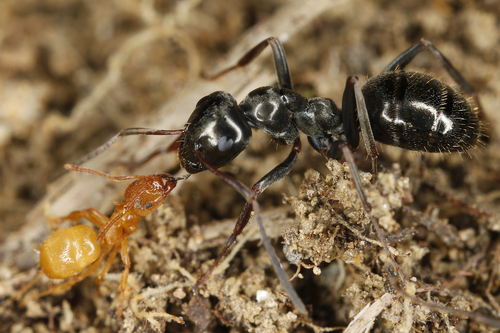
The Formica gagates, commonly known as the Black Shining Ant, is a fascinating and widespread species of wood ant found across parts of Europe. Renowned for its distinctive glossy black exoskeleton, this ant plays a crucial role in forest ecosystems as both a predator and a scavenger. Colonies typically establish themselves within dead wood or beneath stones, where they maintain complex social structures. They are diligent foragers, constantly searching for food resources and contributing to the decomposition process. Their interactions with other species, particularly their mutualistic relationship with aphids, highlight their ecological significance.
Lebensraum: Formica gagates is typically found in diverse forest environments, including coniferous and deciduous woodlands, clearings, and forest edges, often nesting in decaying wood, tree stumps, or under stones and bark.
Workers of Formica gagates are characterized by their uniformly glossy black coloration, giving them a sleek and polished appearance. They possess a typical ant body plan, segmented into a head, thorax, and abdomen, with six slender legs. Worker ants are relatively small, measuring approximately 4 to 7 millimeters in length, making them easy to distinguish from larger ant species by their size and shine. Their antennae are elbowed and prominent.
Kategorie
InsektenSeltenheit
Common
Gefahr
1/5 · Sehr gering
Snaps
Mach den ersten Snap!
Formica gagates workers are known for their incredibly glossy, almost metallic black appearance, which helps them absorb heat when foraging in sunny areas.
Like many Formica species, they construct intricate underground nests or utilize existing dead wood, creating complex tunnel systems that can house thousands of individuals.
The queen of a Formica gagates colony can live for over a decade, continuously laying eggs to sustain the colony's workforce.
Their strong mutualistic relationship with aphids highlights a fascinating example of interspecies cooperation, where ants 'farm' aphids for their sweet secretions.
When threatened, Formica gagates workers can spray a potent stream of formic acid from their abdomens, acting as a chemical deterrent against predators and rival ant species.
These ants engage in a mutualistic relationship with various aphid species, 'herding' them to feed on plant sap and then consuming the sugary honeydew excretions produced by the aphids.
Formica gagates are highly effective scavengers, quickly locating and dismembering dead insects and other organic detritus to bring back to their colony, playing a vital role in nutrient cycling.
Formica gagates has a varied diet, primarily consuming insects and other arthropods, both living prey and carrion. They supplement this protein-rich diet with sugary substances, most notably honeydew collected from aphids.
Acyrthosiphon pisum
These ants protect aphids from predators in exchange for their sugary excretions.
Picus viridis
Formica gagates workers are preyed upon by various insectivorous birds.
Lycosa tarantula
The larvae and pupae of these ants can be consumed by certain predatory spiders.
Formica rufa
These ants often compete with other ant species for food resources and nesting sites.
Für dieses Objekt sind noch keine Merkmal-Badges vergeben.
Noch keine Alternativnamen vorhanden.
Sammlungen für dieses Objekt erscheinen hier, wenn weitere Themen hinzugefügt werden.
Gefahr
1/5 · Sehr gering
Noch keine besonderen Sicherheitshinweise.
Der einfachste Weg, Formica Gagates zu bestimmen, ist die Verwendung der Naturführer-App Snappit.
0 cm
0.000002-0.000005 kg
1-3 Jahre
Formica gagates has a varied diet, primarily consuming insects and other arthropods, both living prey and carrion. They supplement this protein-rich diet with sugary substances, most notably honeydew collected from aphids.
Formica gagates is typically found in diverse forest environments, including coniferous and deciduous woodlands, clearings, and forest edges, often nesting in decaying wood, tree stumps, or under stones and bark.
Foraging
50-300
Zoome hinein, um Cluster aufzulösen und zu sehen, wo dieses Objekt fotografiert wurde.
Neueste Snaps erscheinen hier, wenn neue Beobachtungen hinzukommen.













