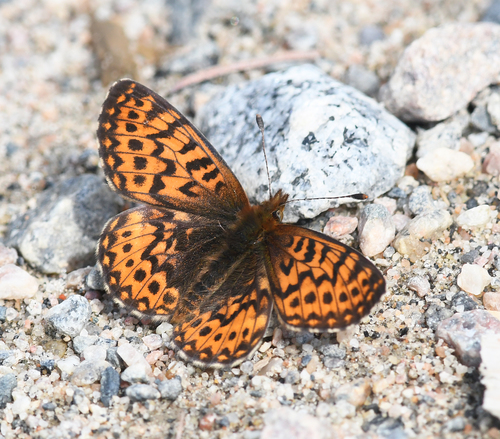


Freija Fritillary
boloria freija
The Freija Fritillary is a charming, hardy butterfly adapted to the chilly, wind-swept environments of the far north and high-altitude alpine zones. Belonging to the brush-footed butterfly family Nymphalidae, this species is a classic circumpolar resident, thriving across the subarctic regions of North America, Europe, and Asia. It is one of the earliest fritillaries to emerge in the spring, often taking wing while snow still clings to the surrounding landscape. What makes the Freija Fritillary particularly remarkable is its extreme resilience. To survive the harsh northern winters, its larvae can enter a state of suspended animation, enduring freezing temperatures that would be fatal to most other insects. As adults, they are nimble fliers, utilizing specialized heat-seeking behavior to stay active on cool, overcast days, making them a true marvel of arctic adaptation.
Lebensraum: Typically found in acidic peat bogs, wet tundra, alpine meadows, and open subarctic boreal forests.
This medium-sized butterfly features a wingspan of 3 to 5 centimeters. The uppersides of its wings are a warm, tawny orange adorned with a complex network of black spots, bars, and zig-zagging lines characteristic of fritillaries. The true identifier lies on the hindwing underside, which displays a beautiful, highly detailed mosaic of rusty brown, yellow, and white bands, highlighted by a prominent, white arrow-shaped mark or chevron pointing outward near the outer margin, alongside a distinctive white median spot.
Kategorie
InsektenSeltenheit
Common
Gefahr
1/5 · Sehr gering
Snaps
Mach den ersten Snap!
In high-latitude arctic habitats, this butterfly may take two full years to complete its lifecycle, overwintering twice as a caterpillar.
It is one of the very first butterfly species to emerge in the spring in subarctic regions, sometimes flying while snow is still on the ground.
The Freija Fritillary is named in honor of Freya (Freyja), the Norse goddess of love, beauty, and fertility.
The caterpillars produce glycerol and other cryoprotectant compounds, allowing them to survive extreme freezing temperatures during winter.
Adults tilt their wings to reflect sunlight directly onto their thorax, raising their body temperature to fly in cold alpine weather.
They fly extremely close to the ground in rapid, unpredictable zig-zag patterns to easily lose avian predators.
Larvae consume the foliage of specific dwarf shrubs and tundra plants, while adults drink nectar from early-blooming subarctic wildflowers.
Altersunterschiede: Larvae feed strictly on the leaves of host plants, whereas adults feed exclusively on liquid nectar.
Vaccinium uliginosum
The caterpillar uses this dwarf shrub as its primary host plant, feeding on its leaves.
Arctostaphylos alpina
Adult butterflies feed on the nectar of this plant, assisting in its pollination.
Poecile hudsonicus
This insectivorous songbird opportunistically preys upon both the caterpillars and adult butterflies.
Für dieses Objekt sind noch keine Merkmal-Badges vergeben.
Noch keine Alternativnamen vorhanden.
Sammlungen für dieses Objekt erscheinen hier, wenn weitere Themen hinzugefügt werden.
Gefahr
1/5 · Sehr gering
Noch keine besonderen Sicherheitshinweise.
Der einfachste Weg, Freija Fritillary zu bestimmen, ist die Verwendung der Naturführer-App Snappit.
10002+ cm
30005+ cm
0.00010003+ kg
10002+ Jahre
15 km/h
Larvae consume the foliage of specific dwarf shrubs and tundra plants, while adults drink nectar from early-blooming subarctic wildflowers.
Typically found in acidic peat bogs, wet tundra, alpine meadows, and open subarctic boreal forests.
Zoome hinein, um Cluster aufzulösen und zu sehen, wo dieses Objekt fotografiert wurde.
Neueste Snaps erscheinen hier, wenn neue Beobachtungen hinzukommen.




.jpg&width=800)









