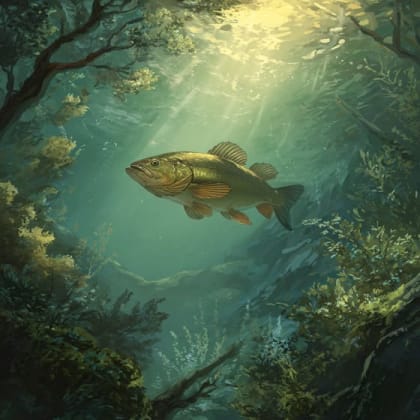
Freshwater Drum
aplodinotus grunniens
The Freshwater Drum, scientifically known as Aplodinotus grunniens, is a fascinating and highly adaptable fish native to the fresh waters of North and Central America. As the sole North American member of the drum family (Sciaenidae) to inhabit freshwater exclusively, it stands out among typical lake and river species. This bottom-dwelling fish is famously named for the distinctive, low-frequency grunting or drumming sounds males produce during the spawning season. These sounds are generated by special muscles vibrating against their swim bladder and can sometimes be heard by humans above the surface on quiet summer evenings. Besides its musical talents, the Freshwater Drum is historically and culturally significant; its massive, ivory-like ear stones, known as otoliths, have been collected as 'lucky stones' for centuries. Ecologically, it plays a vital role as a benthic predator, renowned for its ability to crush hard-shelled prey like the invasive zebra mussel, making it an unsung hero of many freshwater ecosystems.
Lebensraum: Found in the bottom waters of large, clear rivers, deep natural lakes, and expansive reservoirs, typically preferring areas with sandy or gravel substrates.
The Freshwater Drum has a deep, heavy-bodied, and distinctly humpbacked appearance, tapering down to a narrow tail. Its coloration ranges from silvery-gray on the back and sides to a bright, contrasting white belly, often taking on a bronze or brownish hue in murky waters. A key identifying feature is its lateral line, which remarkably extends entirely through its rounded caudal (tail) fin, a hallmark of the drum family. It possesses two dorsal fins that appear joined; the first is supported by stiff, sharp spines, while the second is much longer and composed of soft rays. The fish features a blunt snout with a subterminal mouth positioned slightly underneath, perfectly adapted for bottom feeding.
Kategorie
FischeSeltenheit
Common
Gefahr
1/5 · Sehr gering
Snaps
Mach den ersten Snap!
The freshwater drum is the only North American member of the Sciaenidae family that lives its entire life in freshwater.
Their ear stones, or otoliths, are exceptionally large and ivory-like; they have long been collected by beachcombers and Native Americans as 'lucky stones'.
They are incredibly long-lived; while most live around 7 to 14 years, scientists have found otoliths indicating some individuals have survived for over 70 years.
Unlike most North American freshwater fish that attach their eggs to the bottom, the freshwater drum releases buoyant, pelagic eggs that float freely near the surface.
Males possess specialized sonic muscles that repeatedly strike their swim bladder to create a deep, resonating drumming sound used to attract mates.
They have powerful pharyngeal (throat) teeth specially adapted to crush the hard shells of snails, clams, and mussels.
Their abnormally large inner ear stones provide exceptional balance and sensory perception in deep, murky water environments.
A benthic predator that feeds primarily on hard-shelled mollusks, aquatic insects, and small crustaceans along the water's bottom.
Altersunterschiede: Juveniles feed mostly on zooplankton and small chironomid larvae, shifting heavily toward hard-shelled mollusks, crayfish, and small fish as they mature and develop stronger pharyngeal teeth.
Dreissena polymorpha
Feeds extensively on invasive zebra mussels, acting as a natural biological control agent.
Esox lucius
Juvenile drums are an important food source for large predatory sportfish.
Cyprinus carpio
Competes directly for benthic invertebrate food resources in shared habitats.
Für dieses Objekt sind noch keine Merkmal-Badges vergeben.
Noch keine Alternativnamen vorhanden.
Sammlungen für dieses Objekt erscheinen hier, wenn weitere Themen hinzugefügt werden.
Gefahr
1/5 · Sehr gering
Noch keine besonderen Sicherheitshinweise.
Der einfachste Weg, Freshwater Drum zu bestimmen, ist die Verwendung der Naturführer-App Snappit.
30-75 cm
1-16 kg
7-72 Jahre
25 km/h
A benthic predator that feeds primarily on hard-shelled mollusks, aquatic insects, and small crustaceans along the water's bottom.
Found in the bottom waters of large, clear rivers, deep natural lakes, and expansive reservoirs, typically preferring areas with sandy or gravel substrates.
Foraging
Zoome hinein, um Cluster aufzulösen und zu sehen, wo dieses Objekt fotografiert wurde.
Neueste Snaps erscheinen hier, wenn neue Beobachtungen hinzukommen.

Iowa, US
Hier kann man sehen östliche Erdhummel, Blauer Sonnenbarsch und Forellenbarsch.
Führer anzeigen →

Iowa, US
Hier kann man sehen Amerikanische Kröte und Silberfleck-Dickkopffalter.
Führer anzeigen →

Illinois, US
Hier kann man sehen Amerikanischer Amberbaum und Zuckerahorn.
Führer anzeigen →