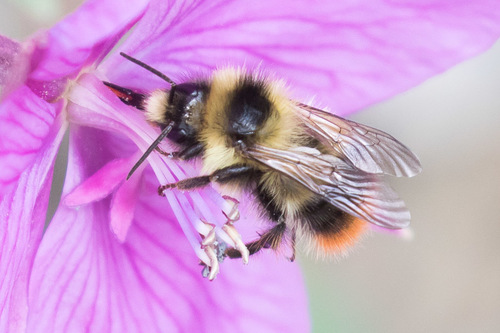


Frigid Bumble Bee
bombus frigidus
The Frigid Bumble Bee (Bombus frigidus) is a resilient, cold-adapted pollinator that thrives in some of North America's harshest northern environments. Ranging across boreal forests, alpine meadows, and tundra, this fuzzy insect plays a vital ecological role in sustaining high-altitude and high-latitude plant life. Because of the extremely short growing seasons in these regions, the Frigid Bumble Bee must forage intensely and efficiently to build its colony before the winter freeze returns. What makes Bombus frigidus truly remarkable is its ability to withstand plunging temperatures that would immobilize most other insects. By shivering its powerful flight muscles, it generates enough internal heat to forage on chilly sub-arctic mornings. Their presence is a welcome sign of summer in the high north, buzzing energetically among fireweed and native blueberries.
Lebensraum: Typically found in cold, northern environments such as boreal forests, alpine meadows, taiga, and tundra margins where blooming flora is concentrated during short summers.
Bombus frigidus is a medium-sized bumblebee characterized by its dense, insulating coat of branched setae (hairs). The thorax is typically covered in bright yellow hair with a distinct black band or central patch between the wing bases. On the abdomen, the first two segments are usually yellow, followed by a band of black, and finishing with a distinctly pale, white, or yellowish-white tail at the tip. Queens are noticeably larger than workers, reaching nearly two centimeters in length, while males have slightly longer antennae and often display more yellow fuzz on their faces.
Kategorie
InsektenSeltenheit
Common
Gefahr
1/5 · Sehr gering
Snaps
Mach den ersten Snap!
Because of the short northern summers, Frigid Bumble Bee colonies must grow, reproduce, and produce new queens in a matter of just a few weeks.
They possess a special pollen basket on their hind legs called a corbicula, which they pack with tightly rolled balls of pollen to carry back to the nest.
To survive the bitter winters of the far north, only the newly mated queens overwinter; the rest of the colony dies off each autumn.
True to its name, frigidus translates to cold or frigid, perfectly describing the icy, high-latitude environments where this bee thrives.
By rapidly contracting and relaxing its flight muscles without moving its wings, the bee can generate internal heat to forage in near-freezing temperatures.
The bee bites down on a flower and vibrates its flight muscles at specific frequencies, effectively shaking hidden pollen free from tubular flowers like blueberries.
Overwintering queens produce natural antifreeze compounds in their bodies to survive being buried underground in sub-zero soil temperatures.
The Frigid Bumble Bee strictly consumes floral resources, collecting protein-rich pollen and energy-dense nectar from northern wild flowers.
Altersunterschiede: Larvae are fed a mixture of pollen and nectar by adult workers, while adults primarily consume nectar for immediate flight energy.
Chamaenerion angustifolium
Provides crucial pollination services while gathering nectar and pollen.
Ursus arctos horribilis
Digs up and consumes entire bumble bee nests for a protein-rich snack.
Physocephala spp.
Internal parasitoids that attack adult foraging bees, often causing them to dig their own graves before dying.
Für dieses Objekt sind noch keine Merkmal-Badges vergeben.
Noch keine Alternativnamen vorhanden.
Sammlungen für dieses Objekt erscheinen hier, wenn weitere Themen hinzugefügt werden.
Gefahr
1/5 · Sehr gering
Noch keine besonderen Sicherheitshinweise.
Der einfachste Weg, Frigid Bumble Bee zu bestimmen, ist die Verwendung der Naturführer-App Snappit.
1-2 cm
2-4 cm
0.0001-0.0008 kg
0-1 Jahre
15 km/h
The Frigid Bumble Bee strictly consumes floral resources, collecting protein-rich pollen and energy-dense nectar from northern wild flowers.
Typically found in cold, northern environments such as boreal forests, alpine meadows, taiga, and tundra margins where blooming flora is concentrated during short summers.
Zoome hinein, um Cluster aufzulösen und zu sehen, wo dieses Objekt fotografiert wurde.
Neueste Snaps erscheinen hier, wenn neue Beobachtungen hinzukommen.


















