

Fruit-Tree Leafroller Moth
archips argyrospila
The Fruit-Tree Leafroller Moth (Archips argyrospila) is a small, common lepidopteran known primarily for the destructive feeding habits of its larval stage. Found across North America and parts of the Old World, this species is a significant agricultural pest, particularly in orchards and deciduous forests. Its life cycle involves overwintering as eggs, followed by voracious larval feeding in spring, and adult emergence in summer. While the adult moth itself is largely harmless, its progeny can cause considerable damage to leaves, buds, and fruit, impacting crop yields and tree health. Understanding its biology is crucial for effective pest management strategies.
Lebensraum: This species is predominantly found in orchards, deciduous forests, woodlands, and suburban gardens where a variety of fruit trees and other broadleaf plants are present.
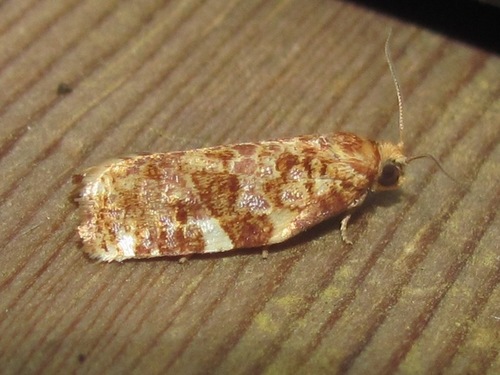
The adult Fruit-Tree Leafroller Moth is a small, rather drab insect with a wingspan typically ranging from 1.8 to 2.5 cm. Its forewings are mottled with shades of brownish-gray, often featuring irregular bands or patches of darker brown, rust, or ochre, which provide excellent camouflage against tree bark. The hindwings are usually a plainer, lighter brown or gray. When at rest, the wings are held in a bell-shaped or triangular profile. The larvae, or caterpillars, are pale green to yellowish-green with a distinct dark head capsule, growing up to 2 cm in length.
Kategorie
InsektenSeltenheit
Common
Gefahr
1/5 · Sehr gering
Snaps
Mach den ersten Snap!
Despite its common name, the Fruit-Tree Leafroller Moth can infest over 50 different species of deciduous trees and shrubs, not just fruit trees.
Early detection of rolled leaves in spring is a key method for orchard managers to identify infestations before significant damage occurs.
The female moth lays eggs in masses of 50-100, typically covered with a protective secretion that hardens into a scale-like covering, camouflaging them on bark.
The larval stage is known for its peculiar habit of rolling leaves and securing them with silk, creating a protective 'tube' or 'tent' to feed within.
Larvae construct shelters by rolling or tying together leaves with silk, providing protection from predators and pesticides while they feed.
This moth can infest a broad range of deciduous trees and shrubs, including numerous fruit tree species, making it adaptable to diverse environments.
Eggs laid in late summer enter diapause, allowing them to survive harsh winter conditions and hatch synchronously with spring bud break.
The larval stage of the Fruit-Tree Leafroller Moth feeds voraciously on the foliage, buds, and developing fruit of a wide variety of deciduous trees, causing significant damage. Adult moths are non-feeding or consume minimal nectar.
Altersunterschiede: Larvae are herbivorous feeders, while adult moths have vestigial mouthparts and do not feed or feed minimally on nectar.
Malus domestica
Larvae feed on leaves and fruit
Prunus avium
Larvae feed on leaves and fruit
Trichogramma minutum
Parasitizes eggs, reducing population
Poecile atricapillus
Adults and larvae are prey for various bird species
Für dieses Objekt sind noch keine Merkmal-Badges vergeben.
Noch keine Alternativnamen vorhanden.
Sammlungen für dieses Objekt erscheinen hier, wenn weitere Themen hinzugefügt werden.
Gefahr
1/5 · Sehr gering
Noch keine besonderen Sicherheitshinweise.
Der einfachste Weg, Fruit-Tree Leafroller Moth zu bestimmen, ist die Verwendung der Naturführer-App Snappit.
0-1 cm
1-2 cm
0.0001-0.0002 kg
0-1 Jahre
The larval stage of the Fruit-Tree Leafroller Moth feeds voraciously on the foliage, buds, and developing fruit of a wide variety of deciduous trees, causing significant damage. Adult moths are non-feeding or consume minimal nectar.
This species is predominantly found in orchards, deciduous forests, woodlands, and suburban gardens where a variety of fruit trees and other broadleaf plants are present.
Foraging
Zoome hinein, um Cluster aufzulösen und zu sehen, wo dieses Objekt fotografiert wurde.
Neueste Snaps erscheinen hier, wenn neue Beobachtungen hinzukommen.









_(7200288182).jpg&width=800)


_female_underside.jpg&width=800)

.jpg&width=800)
