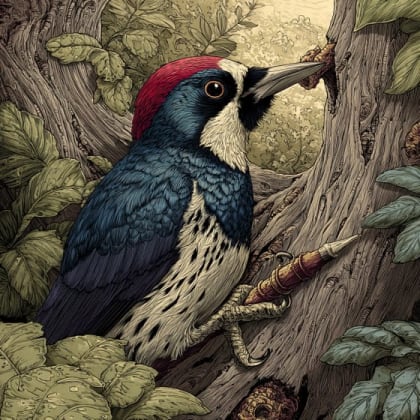



Gadwall
Mareca strepera
The Gadwall is a lovely duck that loves to swim in ponds and lakes. It has a grayish-brown body and is often seen with other ducks, making it a friendly bird to watch!
Lebensraum: Wetlands
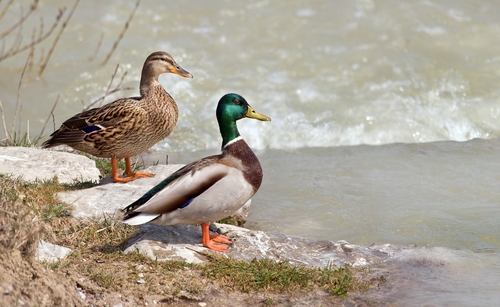
The Gadwall is a medium-sized grey-brown duck. Males have fine patterns on their body, a black rear, and a striking white speculum (wing patch) visible in flight. Females are mottled brown but also possess a white speculum, distinguishing them from many other dabbling ducks.
Kategorie
VögelSeltenheit
Common
Gefahr
1/5 · Sehr gering
Snaps
Mach den ersten Snap!
A female Gadwall might lay her eggs in another duck's nest sometimes!
Gadwall ducks often build their nests far from water, hidden in tall grasses!
These ducks are found all over the world, from America to Asia!
They don't quack much; instead, males make a deep, reedy whistle sound!
Gadwall can tip head-first into water to reach yummy plants at the bottom, helping them find food without fully diving.
The Gadwall has subtle grey-brown plumage that helps it blend perfectly into marshy reeds, making it hard for predators to spot.
Gadwall has a bright white wing patch that flashes in flight, helping flock members stay together and identify each other.
Mostly eats watery plants and their seeds, with some tiny insects, making them primarily herbivores.
Altersunterschiede: Ducklings consume more protein-rich insects for rapid growth, shifting to more plants as they mature.
Haliaeetus leucocephalus
Nests and ducklings are vulnerable to powerful aerial hunters.
Potamogeton crispus
Relies on abundant aquatic vegetation for food source.
Mustela vison
Nests, eggs, and ducklings are prey for river predators.

Sagittaria latifolia
Consumes seeds and tubers from various water plants.
Gefiedert beschreibt Tiere, hauptsächlich Vögel, die ein Federkleid besitzen.
Zeichnet sich durch Zehen aus, die durch eine Membran verbunden sind und normalerweise das Schwimmen erleichtern.
Soziale Tiere leben in organisierten Gruppen und kooperieren, um ihr Überleben zu sichern, beispielsweise bei der Nahrungssuche, Verteidigung und Aufzucht der Jungen.
Filtrierer nehmen Nährstoffe auf, indem sie schwebende Nahrungspartikel und kleine Organismen aus dem Wasser filtern.

Dieses Merkmal kennzeichnet Lebewesen, deren Ernährung vollständig oder hauptsächlich aus pflanzlichem Material besteht.

Dieses Lebensraummerkmal kennzeichnet Arten, die in Feuchtgebieten vorkommen. Dies sind Landflächen, die dauerhaft oder saisonal mit Wasser gesättigt sind, darunter Marschland, Sümpfe und Moore.

Tagaktive Tiere sind hauptsächlich bei Tageslicht aktiv und ruhen oder schlafen in der Regel nachts.

Aquatische Lebensräume umfassen Umgebungen, in denen Organismen überwiegend im Wasser leben, darunter Ozeane, Flüsse, Seen und Feuchtgebiete.

Wandertiere unternehmen saisonale Wanderungen von einer Region in eine andere, meist als Reaktion auf Klimaänderungen oder Nahrungsverfügbarkeit.
Noch keine Alternativnamen vorhanden.
Gefahr
1/5 · Sehr gering
Always watch ducks from a distance and don't feed them bread.
46-58 cm
78-90 cm
0.7-1.3 kg
5-10 Jahre
80 km/h
Mostly eats watery plants and their seeds, with some tiny insects, making them primarily herbivores.
Wetlands
Foraging
Zoome hinein, um Cluster aufzulösen und zu sehen, wo dieses Objekt fotografiert wurde.
Neueste Snaps erscheinen hier, wenn neue Beobachtungen hinzukommen.

Connecticut, US
Hier kann man sehen Singammer, Spottdrossel und Monarch.
Führer anzeigen →

South Holland, NL
Hier kann man sehen Grey Heron, Eurasian Jackdaw und Common Moorhen.
Führer anzeigen →

Washington, US
Hier kann man sehen Ente, American Wigeon und Ringschnabelmöwe.
Führer anzeigen →
Washington, US
Hier kann man sehen Ente, American Coot und Kanadagans.
Führer anzeigen →

Tennessee, US
Hier kann man sehen Red Buckeye, Prairie Trillium und Largeflower Bellwort.
Führer anzeigen →

Washington, US
Hier kann man sehen Kanadagans, Ente und American Coot.
Führer anzeigen →




.jpg&width=800)