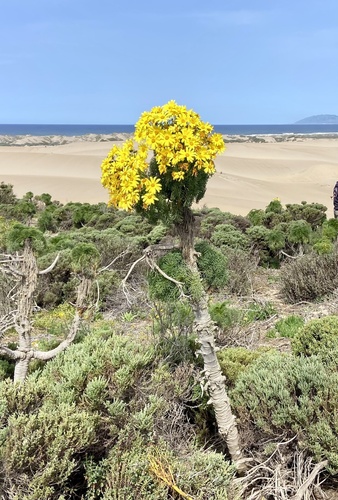


Giant Coreopsis
leptosyne gigantea
The Giant Coreopsis (Leptosyne gigantea) is a spectacular and iconic perennial plant native to the coastal regions of central and southern California, including the Channel Islands. This fascinating species stands out for its unique woody, succulent trunk, which gives it a tree-like appearance, a stark contrast to many of its herbaceous relatives in the sunflower family. Thriving in challenging coastal environments, it is a master of drought adaptation, shedding its fern-like leaves during the dry summer months and bursting into a vibrant display of yellow flowers after winter rains. Its imposing stature and brilliant floral show make it a distinctive feature of the California landscape, attracting numerous pollinators and serving as a testament to the resilience of native flora.
Lebensraum: Found in dry, exposed coastal habitats such as bluffs, hillsides, and chaparral, often in full sun.
The Giant Coreopsis is easily identifiable by its stout, fleshy, unbranched trunk that can grow up to 210 cm tall, topped with a rosette of finely divided, fern-like green leaves. During its blooming season, typically spring, the trunk branches at the top to produce numerous large, bright yellow, daisy-like flowers, each measuring 5-10 cm in diameter, creating a striking crown of color. The succulent stem often appears woody and brown at the base, gradually becoming greener towards the top where the leaves and flowers emerge.
Kategorie
PflanzenSeltenheit
Common
Gefahr
1/5 · Sehr gering
Snaps
Mach den ersten Snap!
During the dry summer months, this plant goes completely dormant, shedding all its leaves and appearing as a bare stick, only to burst back to life with the winter rains.
It is endemic to a very specific and narrow coastal strip of California, making it a true regional specialist.
The Giant Coreopsis is often called a 'tree sunflower' due to its woody stem and large, cheerful yellow flowers, despite being a member of the daisy family.
The Giant Coreopsis sheds its leaves during the prolonged dry season to significantly reduce water loss through transpiration, allowing it to survive arid conditions. New leaves emerge with the onset of winter rains.
Its thick, succulent stems are adapted to store substantial amounts of water, providing a vital reserve during extended periods of drought in its native coastal habitat.
This plant is highly tolerant of the harsh coastal environment, including strong winds, salty air, and nutrient-poor soils, showcasing its resilience in extreme conditions.
As a photosynthetic plant, the Giant Coreopsis produces its own food using sunlight, water, and carbon dioxide. It absorbs essential nutrients from the soil.
Apis mellifera
Pollination
Vanessa cardui
Pollination
Odocoileus hemionus
Herbivory
Artemisia californica
Habitat association
Für dieses Objekt sind noch keine Merkmal-Badges vergeben.
Noch keine Alternativnamen vorhanden.
Sammlungen für dieses Objekt erscheinen hier, wenn weitere Themen hinzugefügt werden.
Gefahr
1/5 · Sehr gering
Noch keine besonderen Sicherheitshinweise.
Der einfachste Weg, Giant Coreopsis zu bestimmen, ist die Verwendung der Naturführer-App Snappit.
60-210 cm
5-30 kg
5-30 Jahre
As a photosynthetic plant, the Giant Coreopsis produces its own food using sunlight, water, and carbon dioxide. It absorbs essential nutrients from the soil.
Found in dry, exposed coastal habitats such as bluffs, hillsides, and chaparral, often in full sun.
Photosynthesis
Zoome hinein, um Cluster aufzulösen und zu sehen, wo dieses Objekt fotografiert wurde.
Neueste Snaps erscheinen hier, wenn neue Beobachtungen hinzukommen.



.jpg&width=800)