

Giant Salamanders
cryptobranchidae
Giant salamanders of the family Cryptobranchidae are living fossils that have remained largely unchanged for over 160 million years. These ancient, fully aquatic amphibians include the largest salamander species on Earth, such as the Chinese and Japanese giant salamanders, as well as the North American hellbender. Spending their entire lives in cool, fast-flowing mountain streams, they possess flat bodies, wrinkled skin, and tiny, lidless eyes that perfectly suit their low-light, riverbed lifestyle. As apex predators of their freshwater ecosystems, they play an essential role in keeping populations of aquatic insects, crayfish, and fish in check.
Lebensraum: Typically found in cool, clear, fast-flowing mountain streams and rivers with abundant large rocks for shelter.
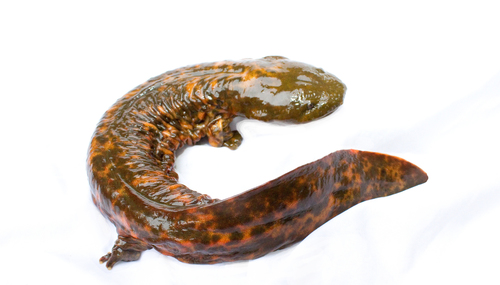
These massive amphibians feature incredibly flat heads and bodies with heavily wrinkled, loose skin along their sides, which increases their surface area for absorbing oxygen. Their coloration is cryptic, ranging from mottled shades of brown, grey, and black to match the rocky riverbeds they inhabit. They have small, lidless eyes, broad mouths, and stout limbs with four toes on the front feet and five on the hind feet. Depending on the species, they can range from 30 centimeters in length to a staggering 1.8 meters, making them easily distinguishable from any other salamander.
Kategorie
AmphibienSeltenheit
Common
Gefahr
1/5 · Sehr gering
Snaps
Mach den ersten Snap!
Because they lack gills as adults and have tiny, inefficient lungs, they perform almost all of their breathing directly through their wrinkled skin.
Giant salamanders are sometimes called 'living fossils' because their lineage dates back over 160 million years to the Jurassic period.
The Chinese Giant Salamander can grow up to 1.8 meters (nearly 6 feet) long, making it the largest amphibian in the world.
When threatened, giant salamanders can secrete a sticky, white mucus that smells like pepper, earning the hellbender the colloquial nickname 'lasagna lizard' due to its wavy skin.
They absorb oxygen directly from the water through highly folded, vascularized skin folds, allowing them to survive without frequently surfacing to breathe.
They drop one side of their lower jaw to create a powerful pressure vacuum, sucking in aquatic prey in milliseconds.
They possess specialized sensory nodes along their head and body that detect minute pressure changes and vibrations in the water.
They are opportunistic aquatic predators that feed primarily on river-dwelling invertebrates and small vertebrates, capturing them using rapid suction.
Faxonius virilis
The Virile Crayfish is a primary food source for adult giant salamanders.
Lontra canadensis
North American River Otters are natural predators of the North American hellbender.
Cottus bairdii
Mottled Sculpins compete with juvenile giant salamanders for shelter under riverbed stones.
Für dieses Objekt sind noch keine Merkmal-Badges vergeben.
Noch keine Alternativnamen vorhanden.
Sammlungen für dieses Objekt erscheinen hier, wenn weitere Themen hinzugefügt werden.
Gefahr
1/5 · Sehr gering
Noch keine besonderen Sicherheitshinweise.
Der einfachste Weg, Giant Salamanders zu bestimmen, ist die Verwendung der Naturführer-App Snappit.
30-180 cm
1.5-50 kg
30-60 Jahre
They are opportunistic aquatic predators that feed primarily on river-dwelling invertebrates and small vertebrates, capturing them using rapid suction.
Typically found in cool, clear, fast-flowing mountain streams and rivers with abundant large rocks for shelter.
Ambush Predator Suction Feeder At Night Using Tactile Sensors To Locate Prey In Rocky Crevices And Darkness Waterways Without Eyesight Assistance Due To Very Poor Vision Underwater Conditions And Low Light Levels Near The Bottom Of The Riverbed By Suctioning It Directly Into Its Mouth Almost Instantly When It Gets Close Enough To Be Captured Successfully Without Escaping At All And Is Then Swallowed Whole Without Chewing It First Because Of Its Teeth Structure Which Are Only Used For Holding Onto Slippery Animals Such As Fish Or Crayfish And Not For Tearing Or Chewing Food Items Into Smaller Pieces Before Swallowing Them Down Its Throat Into Its Stomach For Digestion Later On Over Several Days Time Period Depending On Water Temperature Conditions In The Stream Or River System Where It Lives Currently Located At That Moment In Time And Space On Earth Today Or Historically Speaking As Well Throughout Its Evolutionary History Since The Jurassic Period When Its Ancestors First Appeared On The Planet Millions Of Years Ago Almost Unchanged In Form Since Then According To The Fossil Record Found By Paleontologists Studying Ancient Amphibian Species Extinct Relatives Of Cryptobranchids Worldwide In Different Regions Of The Globe Such As Asia Europe And North America Too
150-500
Zoome hinein, um Cluster aufzulösen und zu sehen, wo dieses Objekt fotografiert wurde.
Neueste Snaps erscheinen hier, wenn neue Beobachtungen hinzukommen.