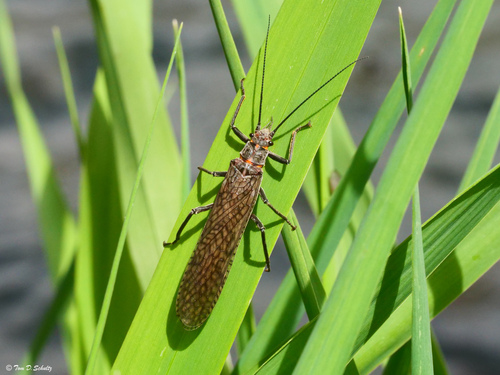


Giant Stoneflies And Salmonflies
pteronarcys
Giant stoneflies and salmonflies belonging to the genus Pteronarcys are among the largest and most impressive aquatic insects in North America. These ancient insects spend the majority of their lives—up to three years—as aquatic nymphs dwelling in clean, fast-flowing, gravelly rivers. Their sudden, massive synchronized hatches in late spring and early summer are legendary among fly fishermen, triggering feeding frenzies in trout populations. As adults, they are easily recognized by their hefty size and fluttery, somewhat clumsy flight. They are incredibly important ecological indicators, as their presence signifies highly oxygenated, pristine water conditions. Their sensitivity to pollution makes them key sentinels for river health.
Lebensraum: Found in clean, cold, highly oxygenated, fast-flowing streams and rivers with rocky or gravelly substrates.
Adults of this genus are remarkably large, measuring between 3 and 7 cm in length, with a robust, flattened, dark gray-to-brown body. They feature striking orange, reddish, or salmon-pink highlights on the underside of their thorax and abdomen, which gives them the common name 'salmonflies.' They have two long antennae, two prominent tail filaments (cerci), and four intricately veined, smoky-translucent wings that fold flat over their back when at rest. Nymphs are dark brown, heavily armored, and feature distinct feathery gills located on the underside of their thoracic segments and the base of their abdomen.
Kategorie
InsektenSeltenheit
Common
Gefahr
1/5 · Sehr gering
Snaps
Mach den ersten Snap!
Giant stoneflies are known as 'clean water sentries' because they are highly intolerant of pollution and disappear quickly if water quality degrades.
The famous 'Salmonfly hatch' on western North American rivers attracts fly anglers from around the world, creating a massive, brief economic boom for local communities.
Their aquatic nymph phase can last up to three full years, during which they undergo over a dozen molts before emerging as adults.
Adults communicate by vibrating their abdomens against rocks or logs, producing species-specific drumming patterns to find mates over distance.
Nymphs possess tufts of highly efficient, feathery gills on their thorax and abdomen, allowing them to extract oxygen from fast-flowing river currents.
They undergo massive, synchronized hatches where thousands of adults emerge simultaneously to overwhelm potential predators through sheer numbers.
Nymphs feed primarily on decaying leaves, woody debris, and algae, while adults rarely feed, relying on energy stored during their aquatic stage.
Oncorhynchus mykiss
Adults and nymphs are a critical, high-calorie food source for trout.
Cinclus mexicanus
Nymphs are actively hunted in shallow, rocky rapids by specialized aquatic birds.
Alnus rhombifolia
Nymphs feed extensively on decaying leaves that fall into streams from lakeside trees.
Für dieses Objekt sind noch keine Merkmal-Badges vergeben.
Noch keine Alternativnamen vorhanden.
Sammlungen für dieses Objekt erscheinen hier, wenn weitere Themen hinzugefügt werden.
Gefahr
1/5 · Sehr gering
Noch keine besonderen Sicherheitshinweise.
Der einfachste Weg, Giant Stoneflies And Salmonflies zu bestimmen, ist die Verwendung der Naturführer-App Snappit.
3-7 cm
5-10 cm
0.001-0.005 kg
1-4 Jahre
5 km/h
Nymphs feed primarily on decaying leaves, woody debris, and algae, while adults rarely feed, relying on energy stored during their aquatic stage.
Found in clean, cold, highly oxygenated, fast-flowing streams and rivers with rocky or gravelly substrates.
Zoome hinein, um Cluster aufzulösen und zu sehen, wo dieses Objekt fotografiert wurde.
Neueste Snaps erscheinen hier, wenn neue Beobachtungen hinzukommen.












.jpg&width=800)



