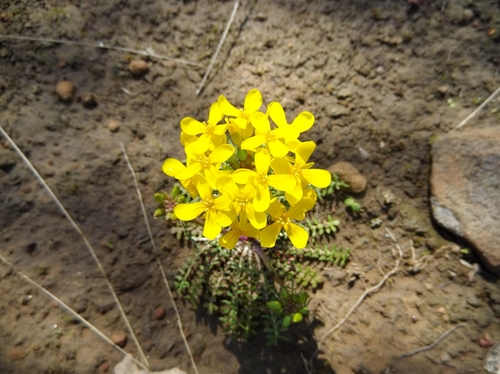


Golden Selenia
selenia aurea
The Golden Selenia (Selenia aurea) is a captivating annual wildflower belonging to the mustard family (Brassicaceae). Native to specific regions of North America, this plant is admired for its striking golden-yellow flowers that herald the arrival of spring. Though often overlooked due to its modest size, Selenia aurea plays a crucial ecological role as an early season bloomer, providing vital nectar and pollen resources for emerging pollinators. Its delicate beauty and resilience in challenging environments make it a fascinating subject for botanists and nature enthusiasts alike, embodying the subtle charm and complex life cycles of desert flora. It's a key indicator of healthy, undisturbed sandy or gravelly soils in its native range.
Lebensraum: Found in open, sandy soils, gravelly slopes, and disturbed areas, often within prairies, deserts, and grasslands.
The Golden Selenia is an herbaceous annual, typically growing between 5 to 20 cm tall. Its erect stems are adorned with deeply lobed, often pinnatifid basal leaves, which form a small rosette. The most distinctive feature are its bright golden-yellow, four-petaled flowers, characteristic of the mustard family, arranged in a dense raceme at the stem's apex. These vibrant blossoms, usually less than 1 cm in diameter, create a brilliant splash of color against the often stark backdrop of its arid habitat, making it easy to spot when in bloom.
Kategorie
PflanzenSeltenheit
Common
Gefahr
1/5 · Sehr gering
Snaps
Mach den ersten Snap!
As a member of the mustard family (Brassicaceae), it shares a distant lineage with familiar cultivated vegetables like broccoli and cabbage, though it is not grown for human consumption.
Despite its delicate appearance, Golden Selenia is remarkably tough, adapted to thrive and complete its life cycle efficiently in harsh, arid conditions where many other plants struggle.
Its genus name, "Selenia," is derived from the Greek word "selene," meaning "moon," possibly referring to the crescent shape of its unique seed pods.
The brilliant yellow color of its flowers makes it a prominent and cheerful sight in spring deserts, often appearing in large, vibrant carpets after winter rains.
Its short annual life cycle allows it to complete reproduction quickly during brief periods of moisture, and its seeds can remain dormant for extended dry spells, waiting for optimal conditions.
Selenia aurea flowers early in spring, capitalizing on available moisture and reduced competition, providing an essential food source for early-emerging insect pollinators.
Like many Brassicaceae members, it produces glucosinolates, secondary metabolites that deter generalist herbivores from consuming its foliage, providing a natural defense mechanism.
The Golden Selenia produces its own food through photosynthesis, utilizing sunlight, carbon dioxide from the air, and water and minerals absorbed from the soil.
Apis mellifera
Provides nectar and pollen to support the early life stages of these insects, acting as a vital food source.
Pieris rapae
Larvae feed on the leaves and stems of Selenia aurea, potentially impacting its growth if populations are high.
Glomus spp.
The plant's roots form a symbiotic relationship with these fungi, enhancing nutrient uptake, especially phosphorus, from nutrient-poor soils.
Amphiachyris dracunculoides
These plants compete for light, water, and soil nutrients in the open, often disturbed, habitats where Golden Selenia grows.
Für dieses Objekt sind noch keine Merkmal-Badges vergeben.
Noch keine Alternativnamen vorhanden.
Sammlungen für dieses Objekt erscheinen hier, wenn weitere Themen hinzugefügt werden.
Gefahr
1/5 · Sehr gering
Noch keine besonderen Sicherheitshinweise.
Der einfachste Weg, Golden Selenia zu bestimmen, ist die Verwendung der Naturführer-App Snappit.
5-20 cm
0.005-0.05 kg
0-1 Jahre
The Golden Selenia produces its own food through photosynthesis, utilizing sunlight, carbon dioxide from the air, and water and minerals absorbed from the soil.
Found in open, sandy soils, gravelly slopes, and disturbed areas, often within prairies, deserts, and grasslands.
Photosynthesis And Nutrient Absorption
50-500
Zoome hinein, um Cluster aufzulösen und zu sehen, wo dieses Objekt fotografiert wurde.
Neueste Snaps erscheinen hier, wenn neue Beobachtungen hinzukommen.