Golden Shiner
notemigonus crysoleucas
The Golden Shiner is a shiny little fish that loves to swim in schools! With its bright golden color, it sparkles like a treasure in the water!
Lebensraum: Freshwater lakes and rivers across North America.
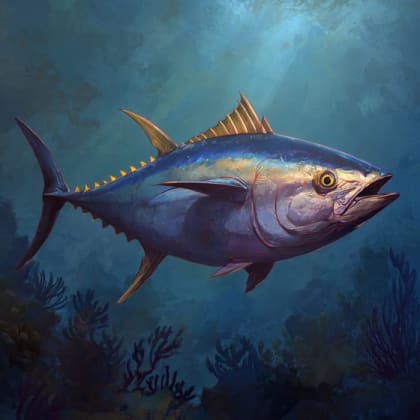
The Golden Shiner has a sleek, compressed body with a small, pointed head. Its sides shimmer with a bright golden-silvery sheen, sometimes showing a faint darker stripe along its length. Large, reflective scales give it a metallic appearance.
Kategorie
FischeSeltenheit
Common
Gefahr
0/5 · Keine bekannte Gefahr
Snaps
Mach den ersten Snap!
Golden Shiners are farmed as popular bait, helping anglers catch bigger fish!
Golden Shiners can survive in water with low oxygen, thriving where other fish cannot!
Their shiny, reflective scales act like tiny mirrors, making them hard for predators to spot!
These fish form massive schools with thousands, moving like a shimmering liquid cloud!
Golden Shiner has highly reflective, silvery scales that help them blend into bright surface waters, confusing predators.
Golden Shiner can gather in large groups because of their strong social instinct, which helps them confuse and deter predators.
Golden Shiner can leap out of the water quickly that helps them escape from fast-moving aquatic predators.
These omnivores eat tiny bugs, algae, and bits of plants they find floating or on the bottom.
Micropterus salmoides
Major predator in many lakes.
Esox niger
Ambushes them from aquatic weeds.
Ardea herodias
Wades in shallow water to snatch.
Daphnia pulex
Feeds on tiny crustaceans.
Soziale Tiere leben in organisierten Gruppen und kooperieren, um ihr Überleben zu sichern, beispielsweise bei der Nahrungssuche, Verteidigung und Aufzucht der Jungen.
Farbenfroh beschreibt Organismen oder Objekte, die eine große Vielfalt an leuchtenden und deutlich erkennbaren Farben aufweisen.
Filtrierer nehmen Nährstoffe auf, indem sie schwebende Nahrungspartikel und kleine Organismen aus dem Wasser filtern.
Tagaktive Tiere sind hauptsächlich bei Tageslicht aktiv und ruhen oder schlafen in der Regel nachts.

Aquatische Lebensräume umfassen Umgebungen, in denen Organismen überwiegend im Wasser leben, darunter Ozeane, Flüsse, Seen und Feuchtgebiete.
Gefahr
0/5 · Keine bekannte Gefahr
Noch keine besonderen Sicherheitshinweise.
7.5-30 cm
0.05-0.2 kg
3-7 Jahre
These omnivores eat tiny bugs, algae, and bits of plants they find floating or on the bottom.
10 km/h
Freshwater lakes and rivers across North America.
Foraging
5 m
Zoome hinein, um Cluster aufzulösen und zu sehen, wo dieses Objekt fotografiert wurde.
Neueste Snaps erscheinen hier, wenn neue Beobachtungen hinzukommen.