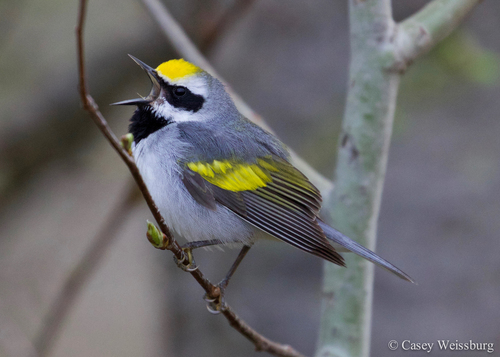


Golden-Winged Warbler
vermivora chrysoptera
The Golden-winged Warbler (Vermivora chrysoptera) is a charismatic and increasingly rare Neotropical migrant songbird, recognized by its striking plumage and distinctive buzzy song. This species is a significant indicator of healthy early-successional habitats, preferring young, regenerating forests, shrubby wetlands, and old fields. Its fascinating ecological story includes a complex relationship with its close relative, the Blue-winged Warbler, with which it readily hybridizes, leading to unique genetic variations like Brewster's and Lawrence's Warblers. Its population has faced severe declines over recent decades, making it a species of high conservation concern and a focal point for habitat restoration efforts across its breeding range.
Lebensraum: Found in early-successional habitats, including regenerating clearcuts, shrubby old fields, beaver clearings, and wetland edges with dense woody shrubs and scattered taller trees.
A small, slender songbird, the male Golden-winged Warbler is instantly recognizable by its bright yellow crown and prominent black throat patch and eye mask, contrasting sharply with its clean white belly and gray back. Its wings bear distinctive golden-yellow patches, giving the species its common name. Females share a similar pattern but are duller, often having a grayish throat patch and less intense black markings. Both sexes exhibit a noticeable white wing bar against their bluish-gray wings, and a short, pointed bill adapted for insect foraging.
Kategorie
VögelSeltenheit
Common
Gefahr
1/5 · Sehr gering
Snaps
Mach den ersten Snap!
A male Golden-winged Warbler often performs an elaborate aerial display during courtship, flying in wide circles above his territory while singing to attract a mate.
Golden-winged Warblers are neotropical migrants, traveling thousands of kilometers between their breeding grounds in North America and their wintering grounds in Central and South America.
Its population has declined by over 60% since 1966, making it one of the most rapidly declining songbirds in North America.
When it hybridizes with the Blue-winged Warbler, the offspring are known as Brewster's Warbler (dominant phenotype) or, less commonly, Lawrence's Warbler (recessive phenotype).
Golden-winged Warblers are adept gleaners, frequently hanging upside down to search for insects and larvae on the undersides of leaves and branches. This allows them to exploit food sources inaccessible to many other warbler species.
Males possess a unique, buzzy song, often transcribed as 'bee-bzz-bzz-bzz', which serves both to establish territory and attract mates. This vocalization is a key identifier and helps differentiate it from other warblers in its habitat.
This species is well-known for its ability to hybridize with the Blue-winged Warbler (Vermivora cyanoptera), producing fertile offspring such as Brewster's Warbler (dominant) and Lawrence's Warbler (recessive). This genetic exchange is a significant factor in its evolutionary and conservation dynamics.
The Golden-winged Warbler is primarily an insectivore, consuming a wide variety of small insects and spiders, particularly during the breeding season when protein demands are high for raising young. Outside of breeding, it may supplement its diet with small fruits or nectar.
Vermivora cyanoptera
Hybridization and competition for breeding habitat, leading to population displacement.
Molothrus ater
Brood parasitism, where the cowbird lays its eggs in the warbler's nest, reducing the warbler's reproductive success.
Arthropoda
Primary food source, particularly larvae.
Cyanocitta cristata
Predation on eggs and nestlings.
Für dieses Objekt sind noch keine Merkmal-Badges vergeben.
Noch keine Alternativnamen vorhanden.
Sammlungen für dieses Objekt erscheinen hier, wenn weitere Themen hinzugefügt werden.
Gefahr
1/5 · Sehr gering
Noch keine besonderen Sicherheitshinweise.
Der einfachste Weg, Golden-Winged Warbler zu bestimmen, ist die Verwendung der Naturführer-App Snappit.
11-13 cm
17-19 cm
0.008-0.011 kg
3-5 Jahre
The Golden-winged Warbler is primarily an insectivore, consuming a wide variety of small insects and spiders, particularly during the breeding season when protein demands are high for raising young. Outside of breeding, it may supplement its diet with small fruits or nectar.
Found in early-successional habitats, including regenerating clearcuts, shrubby old fields, beaver clearings, and wetland edges with dense woody shrubs and scattered taller trees.
Foraging (gleaning, Occasional Hawking)
Zoome hinein, um Cluster aufzulösen und zu sehen, wo dieses Objekt fotografiert wurde.
Neueste Snaps erscheinen hier, wenn neue Beobachtungen hinzukommen.









.jpg&width=800)








