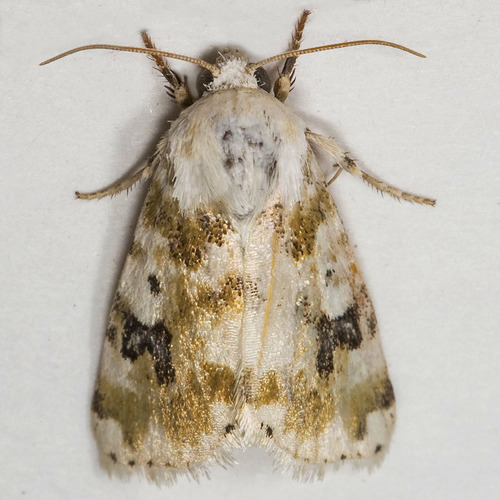


Goldenrod Flower Moth
schinia nundina
The Goldenrod Flower Moth (Schinia nundina) is a fascinating insect perfectly adapted to its primary food source, the goldenrod plant. This small, day-flying moth exhibits remarkable camouflage, blending seamlessly with the yellow flower heads of its host. Its life cycle is intimately tied to goldenrod, with larvae feeding on the developing seeds and adults nectaring from the blossoms. This species is a testament to the intricate ecological relationships found in temperate North American ecosystems, highlighting specialized herbivory and the elegance of natural selection for survival within a specific niche. Its presence often indicates a healthy goldenrod population, serving as a subtle but important component of its local food web.
Lebensraum: Found in open, sunny areas where various species of goldenrod (Solidago spp.) thrive, such as meadows, fields, roadsides, and open woodlands.
This is a small moth, typically with a wingspan of 2.0 to 2.8 cm. Its forewings are predominantly golden-yellow, often with a subtle rosy or orange tinge, and are marked with reddish-brown or purplish-brown patterns. These markings usually include a diagonal band across the middle of the wing and patches that help it mimic the appearance of a spent goldenrod floret or seed head. The hindwings are generally duller, brownish-gray. Its coloration provides exceptional camouflage when resting or feeding on goldenrod flowers, making it difficult to spot.
Kategorie
InsektenSeltenheit
Common
Gefahr
1/5 · Sehr gering
Snaps
Mach den ersten Snap!
Despite being a moth, it is often seen flying and feeding openly during the day, much like a butterfly.
Its incredible camouflage makes it incredibly difficult to spot, even for experienced entomologists; it can literally be sitting on a goldenrod flower and appear as just another part of the plant.
The genus name 'Schinia' is derived from a Greek word meaning 'splendid' or 'magnificent', referring to the often beautiful coloration of these flower moths.
This moth belongs to a diverse group known as 'flower moths,' many of which have highly specialized diets tied to specific flowering plants.
The moth's golden-yellow and reddish-brown coloration perfectly mimics the flowers and developing seeds of goldenrod, allowing it to remain undetected by predators while resting or feeding on the plant.
Larvae of the Goldenrod Flower Moth are obligate feeders on goldenrod species, specifically consuming the flowers and developing seeds. This specialization ensures a consistent food source but also ties the moth's survival directly to the health of goldenrod populations.
Unlike many moths that are nocturnal, Schinia nundina is active during the day. This allows it to feed on goldenrod flowers when they are most active with pollinators, enhancing its chances of finding nectar and mates.
The larvae of the Goldenrod Flower Moth feed exclusively on the flowers and developing seeds of goldenrod plants. Adult moths primarily feed on nectar from goldenrod blossoms.
Altersunterschiede: Larvae consume solid plant material (flowers, seeds); adults consume liquid nectar.
Solidago spp.
The primary host plant for both larvae and adults, providing food and shelter.
Turdus migratorius
These birds are common predators of insects, including moths, in meadows and fields.
Misumena vatia
Various orb-weaving and ambush spiders will prey on moths caught in their webs or ambushed on flowers.
Für dieses Objekt sind noch keine Merkmal-Badges vergeben.
Noch keine Alternativnamen vorhanden.
Sammlungen für dieses Objekt erscheinen hier, wenn weitere Themen hinzugefügt werden.
Gefahr
1/5 · Sehr gering
Noch keine besonderen Sicherheitshinweise.
Der einfachste Weg, Goldenrod Flower Moth zu bestimmen, ist die Verwendung der Naturführer-App Snappit.
0-1 cm
2-3 cm
0.0005-0.001 kg
0 Jahre
The larvae of the Goldenrod Flower Moth feed exclusively on the flowers and developing seeds of goldenrod plants. Adult moths primarily feed on nectar from goldenrod blossoms.
Found in open, sunny areas where various species of goldenrod (Solidago spp.) thrive, such as meadows, fields, roadsides, and open woodlands.
Foraging
Zoome hinein, um Cluster aufzulösen und zu sehen, wo dieses Objekt fotografiert wurde.
Neueste Snaps erscheinen hier, wenn neue Beobachtungen hinzukommen.















