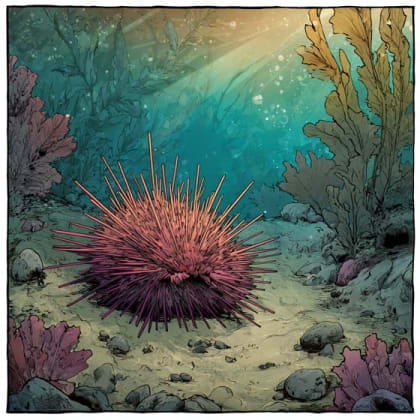
Gooseneck Barnacle
pollicipes polymerus
The Gooseneck Barnacle is a unique sea creature that clings tightly to rocks in the ocean. Its long, flexible stalk allows it to reach up for food while staying securely attached!
Lebensraum: Coastal waters and rocky shorelines
The Gooseneck Barnacle has a long, flexible, reddish-brown stalk, ending in a cluster of white, calcified plates. It often looks like a stony flower or a small, curved neck attached to rocks, with a distinctive dark 'goose neck' base, different from typical flat barnacles.
Kategorie
InvertebrateSeltenheit
Common
Gefahr
0/5 · Keine bekannte Gefahr
Snaps
Mach den ersten Snap!
Barnacles start life as tiny, free-swimming larvae before finding a spot to settle down!
Believe it or not, barnacles are closer relatives to crabs and lobsters than to clams!
Some people in coastal regions consider Gooseneck Barnacles a delicious seafood delicacy!
The glue a barnacle makes is one of the strongest natural adhesives known to science!
Gooseneck Barnacle can stick incredibly tightly to rocks because of a natural, super-strong cement it produces.
Gooseneck Barnacle has feathery legs that help them sweep tiny food from passing water currents into their mouth.
Gooseneck Barnacle has a rubbery stalk that helps them sway with strong ocean waves without breaking off.
These barnacles filter tiny bits of food, like plankton, directly from the ocean water.
Pisaster ochraceus
These sea stars use their suction cups to pull barnacles off rocks.
Nucella lamellosa
This snail can drill into the barnacle's shell to eat the soft tissues.

Haematopus bachmani
These birds use their strong beaks to pry Gooseneck Barnacles off rocks.
Einzelgänger leben den größten Teil ihres Lebens allein und interagieren mit Artgenossen nur zur Paarung oder zur Aufzucht der Jungen.
Filtrierer nehmen Nährstoffe auf, indem sie schwebende Nahrungspartikel und kleine Organismen aus dem Wasser filtern.
Aquatische Lebensräume umfassen Umgebungen, in denen Organismen überwiegend im Wasser leben, darunter Ozeane, Flüsse, Seen und Feuchtgebiete.
Marine Lebensräume umfassen alle Salzwasserumgebungen der Ozeane der Erde und beherbergen eine immense Vielfalt an Wasserlebewesen.
Gefahr
0/5 · Keine bekannte Gefahr
Noch keine besonderen Sicherheitshinweise.
10 cm
25 g
15 Jahre
These barnacles filter tiny bits of food, like plankton, directly from the ocean water.
Coastal waters and rocky shorelines
Filter Feeding
Zoome hinein, um Cluster aufzulösen und zu sehen, wo dieses Objekt fotografiert wurde.
Neueste Snaps erscheinen hier, wenn neue Beobachtungen hinzukommen.