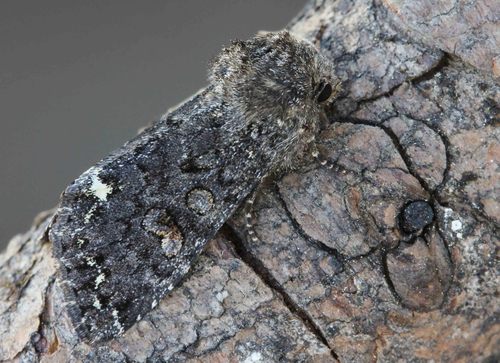


Graphite Arches
melanchra pulverulenta
The Graphite Arches, scientifically known as Melanchra pulverulenta, is a noctuid moth renowned for its subtly elegant appearance and nocturnal habits. This species exemplifies the intricate camouflage found within the moth family, allowing it to blend seamlessly with its natural surroundings. Primarily active at night, it plays a vital role in its ecosystem as both a pollinator in its adult stage and a herbivore during its larval phase. Its presence often indicates a healthy woodland or forest environment, contributing to biodiversity and serving as a food source for various nocturnal predators, embodying the quiet, essential functions of insect life.
Lebensraum: This moth is typically found in diverse forest environments, including mixed deciduous and coniferous woodlands, as well as disturbed forested areas and suburban gardens with ample tree cover.
The Graphite Arches moth typically has a wingspan ranging from 3.5 to 4.5 cm. Its forewings are a mottled blend of dark grey, charcoal, and black, often with subtle olive or brownish tints, giving it a 'graphite' appearance. Distinctive, dark, arching lines and a reniform spot are usually visible, though their prominence can vary. The hindwings are generally a paler, dull grey, darkening towards the outer margins. The body is stout and covered in dark, hairy scales.
Kategorie
InsektenSeltenheit
Common
Gefahr
1/5 · Sehr gering
Snaps
Mach den ersten Snap!
Adult Graphite Arches moths are often attracted to 'sugar traps' or fermented fruit baits set out by enthusiasts, in addition to artificial lights, which can be a good way to observe them up close.
Like many moths, the Graphite Arches uses its antennae to detect pheromones for mating and to navigate in the dark.
The larval stage (caterpillar) of this moth can be found feeding on a wide range of host plants, including both coniferous and deciduous trees, making it a generalist feeder.
The mottled dark grey and black patterns on its forewings allow the Graphite Arches to blend perfectly with tree bark, lichen, and other dark substrates, making it nearly invisible to predators during its resting daytime hours.
Being primarily nocturnal, this moth avoids many diurnal predators and takes advantage of night-blooming flowers for nectar, reducing competition and increasing its survival chances.
The caterpillars are highly adaptable herbivores, capable of feeding on a wide variety of woody plants and herbaceous vegetation, which ensures a diverse food supply and greater resilience to habitat changes.
The diet of the Graphite Arches changes significantly with age. As larvae (caterpillars), they are herbivores, feeding on the foliage of various plants. Adult moths primarily feed on nectar, though some may not feed at all, relying on energy reserves built during the larval stage.
Altersunterschiede: Larvae are foliage-eating herbivores. Adults are primarily nectarivores, or non-feeding.
Acer rubrum
Primary larval food source
Pinus strobus
Primary larval food source
Myotis lucifugus
Nocturnal predator of adult moths
Poecile atricapillus
Diurnal predator of resting adults
Für dieses Objekt sind noch keine Merkmal-Badges vergeben.
Noch keine Alternativnamen vorhanden.
Sammlungen für dieses Objekt erscheinen hier, wenn weitere Themen hinzugefügt werden.
Gefahr
1/5 · Sehr gering
Noch keine besonderen Sicherheitshinweise.
Der einfachste Weg, Graphite Arches zu bestimmen, ist die Verwendung der Naturführer-App Snappit.
1-2 cm
3-4 cm
0.001-0.002 kg
The diet of the Graphite Arches changes significantly with age. As larvae (caterpillars), they are herbivores, feeding on the foliage of various plants. Adult moths primarily feed on nectar, though some may not feed at all, relying on energy reserves built during the larval stage.
This moth is typically found in diverse forest environments, including mixed deciduous and coniferous woodlands, as well as disturbed forested areas and suburban gardens with ample tree cover.
Foraging
150-300
Zoome hinein, um Cluster aufzulösen und zu sehen, wo dieses Objekt fotografiert wurde.
Neueste Snaps erscheinen hier, wenn neue Beobachtungen hinzukommen.



_(6140462122).jpg&width=800)