

Grass Spiders
agelenopsis
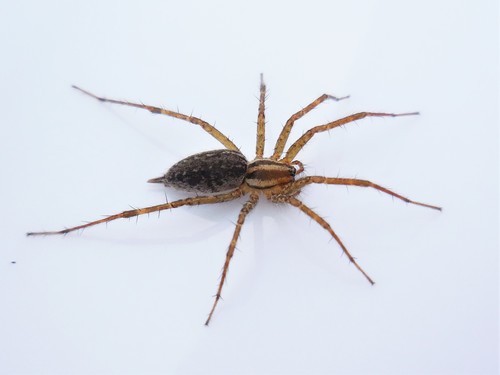
Grass spiders of the genus Agelenopsis are highly active, beneficial arachnids famous for weaving flat, sheet-like webs across lawns, fields, and low shrubbery. Unlike typical orb-weavers, these spiders do not rely on sticky silk to trap their prey. Instead, they construct a non-sticky platform with a funnel-shaped retreat at one end. They wait patiently in this dark tunnel until an unsuspecting insect lands on the web, then dash out with lightning speed to subdue it. They are harmless to humans, rarely biting unless squeezed, and are beneficial allies in gardens by consuming vast quantities of pest insects.
Lebensraum: Typically found in grassy lawns, meadows, low-lying shrubs, and around building foundations where they can secure their sheet webs.
Grass spiders are medium-sized arachnids, typically brownish or grayish in color with two prominent, dark longitudinal stripes running down the length of the cephalothorax. Their abdomen features a lighter, chevron-like pattern and, most distinctively, a pair of exceptionally long, finger-like spinnerets protruding from the rear. Their long, hairy legs are often patterned with dark bands, giving them a slightly mottled appearance that blends perfectly with dry grass and leaf litter.
Kategorie
InvertebrateSeltenheit
Common
Gefahr
1/5 · Sehr gering
Snaps
Mach den ersten Snap!
Dewy mornings are the best time to see their webs, as water droplets cling to the fine silk, revealing hundreds of hidden funnels across a single lawn.
Their webs are entirely non-sticky, meaning they must rely purely on their fast-running abilities to catch prey before it flies away.
They have extremely long spinnerets at the back of their abdomen, which act like precision nozzles to lay down their flat sheets of silk.
Relying on speed rather than sticky silk, these spiders can run across their webs at incredibly high velocities to intercept prey.
They use highly sensitive hairs on their legs to instantly pinpoint the exact location of vibrations made by insects landing on their web.
They weave a funnel-like tunnel that has a secondary escape opening at the back, allowing them to flee if a predator enters the front.
Grass spiders sit inside their funnel retreats and rush out to capture insects that land on the flat web sheets.
Altersunterschiede: Young spiderlings consume tiny insects like aphids, while mature adults tackle larger prey like grasshoppers.
Melanoplus differentialis
Preys on grasshoppers that land on its web.
Turdus migratorius
Commonly preyed upon by insect-eating birds.
Chalybion californicum
Paralyzed and dragged away by solitary wasps to feed their larvae.
Für dieses Objekt sind noch keine Merkmal-Badges vergeben.
Noch keine Alternativnamen vorhanden.
Sammlungen für dieses Objekt erscheinen hier, wenn weitere Themen hinzugefügt werden.
Gefahr
1/5 · Sehr gering
Noch keine besonderen Sicherheitshinweise.
Der einfachste Weg, Grass Spiders zu bestimmen, ist die Verwendung der Naturführer-App Snappit.
1-2 cm
0.0001-0.001 kg
1 Jahre
2 km/h
Grass spiders sit inside their funnel retreats and rush out to capture insects that land on the flat web sheets.
Typically found in grassy lawns, meadows, low-lying shrubs, and around building foundations where they can secure their sheet webs.
Ambush
Zoome hinein, um Cluster aufzulösen und zu sehen, wo dieses Objekt fotografiert wurde.
Neueste Snaps erscheinen hier, wenn neue Beobachtungen hinzukommen.