

Great Barracuda
sphyraena barracuda
The Great Barracuda is a legendary predator of the tropical oceans, known for its sleek, torpedo-shaped body and formidable presence. Often found patrolling coral reefs, mangroves, and open coastal waters, this solitary hunter commands respect with its razor-sharp teeth and lightning-fast bursts of speed. Despite their fearsome reputation and curious nature—often following divers in clear water—unprovoked attacks on humans are exceptionally rare, as they are primarily visual hunters focused on smaller fish. As apex predators, Great Barracudas play a vital role in maintaining the balance of marine ecosystems by regulating the populations of herbivorous and smaller carnivorous fish, preventing overgrazing on coral reefs and ensuring a healthy, biodiverse underwater habitat.
Lebensraum: Found in warm, tropical and subtropical marine waters, typically associated with coral reefs, seagrass beds, mangroves, and open coastal zones.
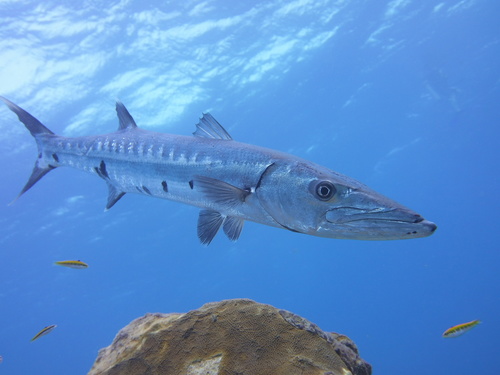
Characterized by a long, cylindrical body that tapers at both ends, the Great Barracuda features a silvery coloration with a blue-gray to dark green back and a white belly. It is distinguished by dark, irregular spots or splotches scattered along its lower sides, and a series of dark double-band-like patterns across its back. Its most striking features are its large, undershot jaw lined with prominent, dagger-like teeth, and its two widely separated dorsal fins, which contribute to its hydrodynamic efficiency.
Kategorie
FischeSeltenheit
Common
Gefahr
1/5 · Sehr gering
Snaps
Mach den ersten Snap!
Despite their fearsome appearance, they are quite curious and will often shadow snorkelers and divers out of sheer interest rather than aggression.
Large, older barracudas can accumulate ciguatoxin in their flesh, a naturally occurring toxin from reef algae that causes severe food poisoning in humans.
They are highly attracted to shiny objects like jewelry and dive knives, which they can mistake for the glint of silver prey fish.
Launches explosive, high-speed ambush attacks using its powerful tail fin, engulfing prey before they can react.
Features a dark back and silvery belly, blending seamlessly with the dark ocean depth from above and the bright surface from below.
Possesses highly developed eyes sensitive to sudden glints of light, allowing it to easily spot silver-scaled fish in turbulent water.
A relentless predator that feeds almost exclusively on other marine fish, using rapid acceleration to ambush its prey.
Galeocerdo cuvier
Adult barracudas are occasionally preyed upon by large reef predators like tiger sharks.
Labroides dimidiatus
Visits cleaning stations where the wrasse removes parasites from its skin and gills.
Epinephelus striatus
Competes for similar small reef fish prey within coral reef environments.
Für dieses Objekt sind noch keine Merkmal-Badges vergeben.
Noch keine Alternativnamen vorhanden.
Sammlungen für dieses Objekt erscheinen hier, wenn weitere Themen hinzugefügt werden.
Gefahr
1/5 · Sehr gering
Noch keine besonderen Sicherheitshinweise.
Der einfachste Weg, Great Barracuda zu bestimmen, ist die Verwendung der Naturführer-App Snappit.
60-200 cm
2-46 kg
10-14 Jahre
58 km/h
A relentless predator that feeds almost exclusively on other marine fish, using rapid acceleration to ambush its prey.
Found in warm, tropical and subtropical marine waters, typically associated with coral reefs, seagrass beds, mangroves, and open coastal zones.
Ambushblockeredarttypeperhapsbutessentiallyambushorpursuitbyexplosivespeed Let'ssticktoambushorpursuit Ambush Isbest Huntingmethodisambushinschemainstruction Let'suseambushvaluewhichisstandardandcorrect.let'srefinetoplain'ambush'asstring.wait,theschemasaystype'string'or'null'forhuntingmethod.let'suse'ambush'.anddietchangeswithage:'juveniles Feed On Small Gobies And Silversides In Shallow Mangroves, While Adults Target Much Larger Reef Fishes.'
Zoome hinein, um Cluster aufzulösen und zu sehen, wo dieses Objekt fotografiert wurde.
Neueste Snaps erscheinen hier, wenn neue Beobachtungen hinzukommen.