

Great Basin Bristlecone Pine
pinus longaeva
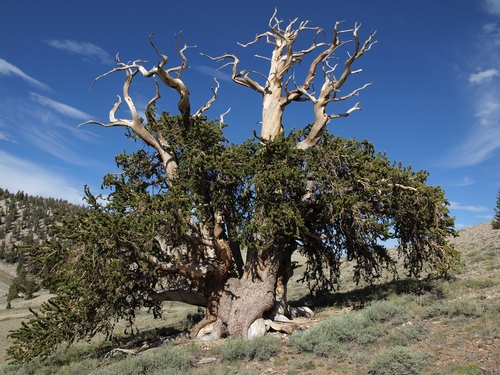
The Great Basin Bristlecone Pine (Pinus longaeva) is a legendary conifer famous for being among the oldest living non-clonal organisms on Earth. Thriving in the harsh, high-altitude environments of the western United States, these resilient trees grow incredibly slowly in cold, dry, and windy conditions. Over millennia, the relentless elements sculpt their trunks into dramatic, gnarled, and twisted forms, with much of their wood remaining exposed and polished to a beautiful sheen rather than covered in bark. These trees have adapted to thrive where almost nothing else can survive, growing in nutrient-poor alkaline soils. Their extremely dense, resinous wood is highly resistant to rot, fungi, and insect pests, allowing them to remain standing for thousands of years even after they die.
Lebensraum: Found in high-altitude subalpine zones and windswept mountain ridges of the Great Basin, typically growing in dry, nutrient-poor dolomite soils near the tree line.
This slow-growing, medium-sized tree typically reaches heights of 500 to 1500 centimeters, exhibiting a highly distinctive gnarled, stunted, and twisted growth form shaped by wind and ice. Its bark is thin and bright orange-yellow when young, weathering to a dark gray or reddish-brown with deep fissures on surviving sections. The needles are deep green to blue-green, occurring in tightly packed, long-lasting clusters of five that completely wrap around the twigs, giving them a bottle-brush appearance. The female cones are cylindrical-ovoid, reddish-purple when young and maturing to brown, characterized by a sharp, prominent prickle or 'bristle' on each scale.
Kategorie
PflanzenSeltenheit
Common
Gefahr
1/5 · Sehr gering
Snaps
Mach den ersten Snap!
Because of their slow growth and immense age, their tree rings provide an incredibly precise climatic record used by scientists to calibrate radiocarbon dating scales.
Even after a bristlecone pine dies, its dense, resinous wood can remain standing on its roots for up to 2,000 years before finally decaying or falling.
The oldest known living individual, named 'Methuselah,' is estimated to be over 4,850 years old, meaning it sprouted before the Great Pyramid of Giza was built.
The wood is extremely dense and saturated with resin, preventing decay, fungal rot, and boring insect infestations for thousands of years.
They can survive with only a narrow strip of living bark and cambium connecting the roots to a few living branches, allowing the rest of the tree to die off to conserve resources.
They thrive in alkaline, nutrient-poor, calcium-magnesium-rich carbonate soils where most other plants cannot survive, effectively eliminating competition.
As a photosynthetic plant, the Great Basin Bristlecone Pine produces its own food using sunlight, carbon dioxide, water, and soil nutrients.
Nucifraga columbiana
Disperses the seeds of the bristlecone pine by caching them in the ground for winter food.
Pinus flexilis
Competes for soil nutrients, moisture, and space in the subalpine zone.
Erethizon dorsatum
Occasionally feeds on the bark and cambium of young branches, which can damage the tree.
Für dieses Objekt sind noch keine Merkmal-Badges vergeben.
Sammlungen für dieses Objekt erscheinen hier, wenn weitere Themen hinzugefügt werden.
Gefahr
1/5 · Sehr gering
Noch keine besonderen Sicherheitshinweise.
Der einfachste Weg, Great Basin Bristlecone Pine zu bestimmen, ist die Verwendung der Naturführer-App Snappit.
500-1500 cm
1000-5000 Jahre
As a photosynthetic plant, the Great Basin Bristlecone Pine produces its own food using sunlight, carbon dioxide, water, and soil nutrients.
Found in high-altitude subalpine zones and windswept mountain ridges of the Great Basin, typically growing in dry, nutrient-poor dolomite soils near the tree line.
Zoome hinein, um Cluster aufzulösen und zu sehen, wo dieses Objekt fotografiert wurde.
Neueste Snaps erscheinen hier, wenn neue Beobachtungen hinzukommen.

Colorado, US
Hier kann man sehen Great Basin Bristlecone Pine und Maultierhirsch.
Führer anzeigen →

Colorado, US
Hier kann man sehen Great Basin Bristlecone Pine und Weidenröschen.
Führer anzeigen →

Colorado, US
Hier kann man sehen Dickhornschaf, Zitterpappel und Goldmantelziesel.
Führer anzeigen →

California, US
Hier kann man sehen Mammutbaum, Maultierhirsch und Gelbbauchmurmeltier.
Führer anzeigen →

Colorado, US
Hier kann man sehen Great Basin Bristlecone Pine, Black Rosy-Finch und Rotfuchs.
Führer anzeigen →