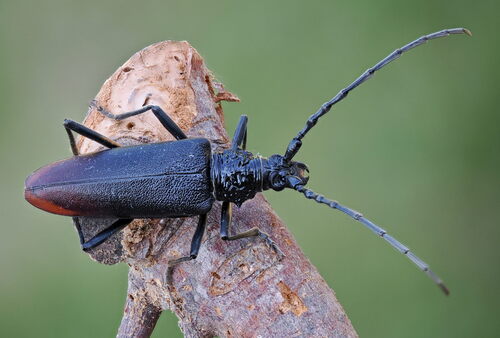


Great Capricorn Beetle
cerambyx cerdo
The Great Capricorn Beetle is one of Europe's largest and most impressive insect species, renowned for its striking size and magnificent antennae. As a key member of the longhorn beetle family, this insect plays an important ecological role in forest ecosystems by colonizing older, weakened deciduous trees, particularly ancient oaks. Its presence is often a vital indicator of high-biodiversity old-growth woodland habitats, which are increasingly rare across its native European range. Although adults have a relatively short lifespan of just a few weeks, the species spends the majority of its life cycle as a hidden wood-boring larva deep within the trunks of majestic oaks. For nature enthusiasts, catching a glimpse of this nocturnal giant crawling along rugged oak bark on a warm summer evening is a thrilling and unforgettable wildlife encounter.
Lebensraum: Found in old-growth deciduous forests, wood-pastures, and historic parklands containing ancient, sun-exposed oak trees.
This large beetle features an elongated, robust body measuring between 3 to 6 centimeters, with a coloration that transitions from deep black on the head and thorax to a rich, reddish-brown near the tips of its wing covers (elytra). Its most defining feature is its exceptionally long, segmented antennae; in males, these can extend up to twice the total length of the body, while the female's antennae are slightly shorter, matching her body length. The thorax is heavily wrinkled or rugose, and its powerful legs terminate in grippy claws designed for climbing rough tree bark.
Kategorie
InsektenSeltenheit
Common
Gefahr
1/5 · Sehr gering
Snaps
Mach den ersten Snap!
Despite their formidable appearance and powerful jaws, adult Great Capricorn Beetles are entirely harmless to humans.
The beetle gets its name from the long, curved antennae of the male, which resemble the horns of a wild ibex or capricorn.
The larval stage of this beetle lasts between three and five years, while the adult beetle lives for only a few weeks to a couple of months.
When threatened, the beetle can rub its prothorax against its mesothorax to produce a loud squeaking sound intended to startle predators.
The larvae harbor specialized gut microbes that allow them to digest tough cellulose and lignin from old oak wood over several years.
Their massive antennae are packed with sensitive receptors, helping males detect female pheromones and fermenting oak sap from great distances.
Larvae feed exclusively on the inner wood of oak trees, while adult beetles consume sugary tree sap, nectar, and sweet ripe fruits.
Altersunterschiede: Larvae are strictly xylophagous, boring into and consuming solid oak wood, whereas adult beetles feed on liquid sap and soft plant matter.
Quercus robur
Larvae develop within and feed on the inner heartwood of mature trees.
Dendrocopos major
Predators that extract the beetle's large, fat larvae from tree trunks.
Vespa crabro
Competes with the beetle for access to fermenting sap wounds on oak bark.
Für dieses Objekt sind noch keine Merkmal-Badges vergeben.
Noch keine Alternativnamen vorhanden.
Sammlungen für dieses Objekt erscheinen hier, wenn weitere Themen hinzugefügt werden.
Gefahr
1/5 · Sehr gering
Noch keine besonderen Sicherheitshinweise.
Der einfachste Weg, Great Capricorn Beetle zu bestimmen, ist die Verwendung der Naturführer-App Snappit.
3-6 cm
8-12 cm
0.002-0.006 kg
3-5 Jahre
5 km/h
Larvae feed exclusively on the inner wood of oak trees, while adult beetles consume sugary tree sap, nectar, and sweet ripe fruits.
Found in old-growth deciduous forests, wood-pastures, and historic parklands containing ancient, sun-exposed oak trees.
Zoome hinein, um Cluster aufzulösen und zu sehen, wo dieses Objekt fotografiert wurde.
Neueste Snaps erscheinen hier, wenn neue Beobachtungen hinzukommen.
















