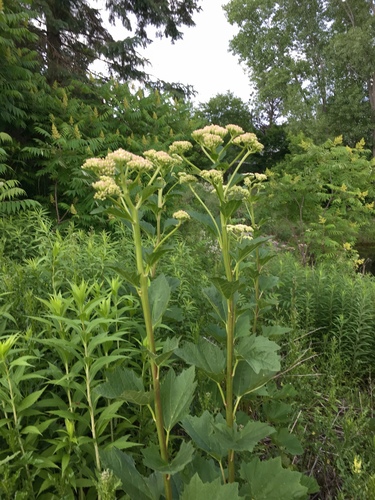


Great Indian Plantain
arnoglossum reniforme
The Great Indian Plantain (Arnoglossum reniforme) is a striking, tall perennial wildflower native to the rich, moist forests of the eastern and central United States. Despite its common name, it is not a true plantain but rather a member of the diverse aster family (Asteraceae). Standing as a giant among forest herbs, this plant can reach impressive heights of over eight feet, commands attention with its massive, fan-shaped lower leaves, and produces flat-topped clusters of creamy white flowers. It thrives in shaded, nutrient-rich woodland environments, contributing to the biodiversity of damp forest floors and riverbanks. This species plays an important ecological role by providing nectar to a variety of pollinating insects, including bees, wasps, and butterflies, while its lush foliage offers shelter for ground-dwelling forest wildlife. Encountering this botanical giant in a secluded glen is a highlight for any native plant enthusiast.
Lebensraum: Found in rich, moist deciduous woods, alluvial floodplains, and shaded calcareous slopes.
The Great Indian Plantain is easily identified by its immense, deeply-veined, kidney-shaped (reniform) lower leaves, which can measure up to 30 centimeters across and feature coarsely-toothed margins. The leaves become progressively smaller and more lance-shaped as they ascend the thick, deeply grooved, light green stem. At the peak of the plant, dense, flat-topped clusters (corymbs) display small, star-like tubular flowers that are greenish-white to creamy white, notably lacking the outer ray petals common to other asters.
Kategorie
PflanzenSeltenheit
Common
Gefahr
1/5 · Sehr gering
Snaps
Mach den ersten Snap!
The specific epithet 'reniforme' translates directly to 'kidney-shaped', highlighting its incredibly unique basal leaf shape.
This species can reach towering heights of up to 2.5 meters in a single growing season, dying back completely to its rootstock every winter.
Unlike many of its relatives in the Asteraceae family, its flower heads completely lack showy ray petals, consisting entirely of fertile disk florets.
Produces massive, broad basal leaves designed to capture maximum sunlight filtering through dense forest canopies.
Features a deeply grooved, hollow stem that provides exceptional structural integrity, allowing it to stand upright at heights up to eight feet without woody tissue.
Synthesizes pyrrolizidine alkaloids within its tissues to deter herbivores and insect pests from feeding on its lush foliage.
As a photoautotroph, the Great Indian Plantain manufactures its own organic compounds using sunlight, water, carbon dioxide, and essential soil minerals through photosynthesis.
Bombus bimaculatus
Feeds on nectar and pollen, acting as a primary pollinator for the flower heads.
Estigmene acrea
The leaves are consumed by caterpillars as a larval food source.
Für dieses Objekt sind noch keine Merkmal-Badges vergeben.
Noch keine Alternativnamen vorhanden.
Sammlungen für dieses Objekt erscheinen hier, wenn weitere Themen hinzugefügt werden.
Gefahr
1/5 · Sehr gering
Noch keine besonderen Sicherheitshinweise.
Der einfachste Weg, Great Indian Plantain zu bestimmen, ist die Verwendung der Naturführer-App Snappit.
100-250 cm
0.5-2 kg
3-10 Jahre
As a photoautotroph, the Great Indian Plantain manufactures its own organic compounds using sunlight, water, carbon dioxide, and essential soil minerals through photosynthesis.
Found in rich, moist deciduous woods, alluvial floodplains, and shaded calcareous slopes.
Photosynthesis
Zoome hinein, um Cluster aufzulösen und zu sehen, wo dieses Objekt fotografiert wurde.
Neueste Snaps erscheinen hier, wenn neue Beobachtungen hinzukommen.