

Great Plains Giant Tiger Beetle
amblycheila cylindriformis
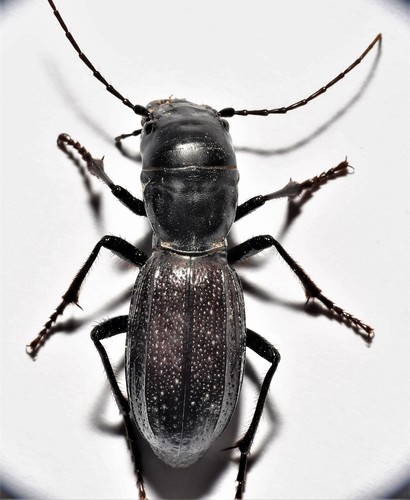
The Great Plains Giant Tiger Beetle (Amblycheila cylindriformis) is a fascinating, unusually large member of the tiger beetle family. Unlike its brightly colored, sun-loving, and hyper-agile cousins, this species has completely adapted to a flightless, nocturnal lifestyle. It slowly stalks the plains and clay banks of the central United States under the cover of darkness, relying on its formidable, sickle-like mandibles to crush heavily armored prey. Historically, this remarkable insect was shrouded in mystery. During the Victorian era, it was considered one of the rarest beetles in North America, with wealthy collectors paying premium prices for a single specimen. Today, while no longer considered extraordinarily rare, finding one is still a thrilling experience for entomologists and nature enthusiasts who venture into the semi-arid prairies at night.
Lebensraum: Found primarily in the semi-arid shortgrass prairies, scrublands, and steep clay banks of the American Great Plains.
This tiger beetle has a robust, elongated, and somewhat cylindrical body, giving it the species name 'cylindriformis'. It is completely flightless, with its dark brown to pitch-black wing covers (elytra) fused together. It typically measures between 3 and 4 centimeters in length, making it a giant among tiger beetles. It features long, spindly legs designed for striding across rough terrain, large prominent eyes adapted for low-light vision, and massive, asymmetrical, heavily toothed mandibles that cross over each other at the front of its head.
Kategorie
InsektenSeltenheit
Common
Gefahr
1/5 · Sehr gering
Snaps
Mach den ersten Snap!
In the 1870s, this beetle was so prized by collectors that pristine specimens sold for astronomical sums, equivalent to hundreds of dollars today.
Its larvae can dig vertical burrows that plunge nearly a meter deep into hard clay soil, taking up to two years to fully develop into adults.
Unlike typical tiger beetles that are incredibly fast, sun-loving sprinters, this species traded speed and flight for heavy armor and a nocturnal lifestyle.
Equipped with massive, heavily toothed jaws that easily pierce and crush the tough exoskeletons of other insects and arthropods.
It possesses highly sensitive compound eyes that allow it to effectively navigate and hunt under the faint light of the moon and stars, avoiding the daytime heat.
As larvae, they dig perfectly cylindrical, vertical burrows in clay soil where they anchor themselves and wait to ambush passing insects from below.
A voracious nocturnal predator that feeds on a wide variety of ground-dwelling arthropods.
Altersunterschiede: Larvae are strictly ambush predators waiting in burrows, while adults are active, roaming hunters.
Onychomys leucogaster
Preyed upon by nocturnal desert and plains rodents.
Eleodes hispilabris
Hunts large, ground-dwelling beetles during its nocturnal foraging.
Anaxyrus cognatus
Opportunistically eaten by nocturnal amphibians foraging in the same habitat.
Für dieses Objekt sind noch keine Merkmal-Badges vergeben.
Noch keine Alternativnamen vorhanden.
Sammlungen für dieses Objekt erscheinen hier, wenn weitere Themen hinzugefügt werden.
Gefahr
1/5 · Sehr gering
Noch keine besonderen Sicherheitshinweise.
Der einfachste Weg, Great Plains Giant Tiger Beetle zu bestimmen, ist die Verwendung der Naturführer-App Snappit.
3-4 cm
0.001-0.003 kg
1-3 Jahre
2 km/h
A voracious nocturnal predator that feeds on a wide variety of ground-dwelling arthropods.
Found primarily in the semi-arid shortgrass prairies, scrublands, and steep clay banks of the American Great Plains.
Pursuit
Zoome hinein, um Cluster aufzulösen und zu sehen, wo dieses Objekt fotografiert wurde.
Neueste Snaps erscheinen hier, wenn neue Beobachtungen hinzukommen.




.jpg&width=800)















