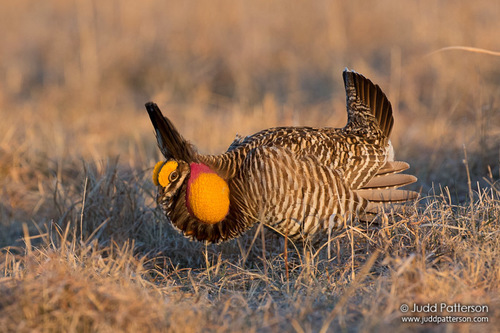


Greater Prairie-Chicken
tympanuchus cupido
The Greater Prairie-Chicken is an iconic and charismatic bird of North America's native grasslands, famous for one of the most spectacular mating rituals in the avian world. During early spring, males gather on communal display grounds known as leks. Here, they perform elaborate dances, stomp their feet, and inflate bright orange air sacs on their necks to produce a deep, haunting 'booming' call that echoes across the prairie. This remarkable display is a testament to the wild beauty of the vanishing tallgrass prairie ecosystem. Historically ranging across vast sweeps of the American Midwest, these birds are now symbols of conservation. Their dependency on intact grasslands makes them an indicator species for the health of native prairies. Spotting one of these birds, particularly during their dawn lekking displays, is an unforgettable experience for birdwatchers and nature enthusiasts alike.
Lebensraum: Found in expansive, open tallgrass and mixed-grass prairies, often requiring a mosaic of high-quality grassland habitats for nesting, brood rearing, and winter survival.
The Greater Prairie-Chicken is a medium-sized, stocky grouse with overall brown and buff barring across its entire body, providing excellent camouflage in dry grasses. Males feature dramatic visual adornments used in courtship: bright yellow-orange combs over their eyes, elongated dark neck feathers (pinnae) that can be raised like horns, and large, bare orange gular (throat) sacs that inflate like balloons during displays. Females are slightly smaller and more cryptically colored, lacking the colorful eye combs and air sacs, with barred tails unlike the solid dark tails of mature males.
Kategorie
VögelSeltenheit
Common
Gefahr
1/5 · Sehr gering
Snaps
Mach den ersten Snap!
During their mating displays, male Greater Prairie-Chickens stomp their feet up to 20 times per second, making a rapid drumming sound.
Once numbering in the millions across the Midwestern grasslands, their habitat has been reduced to tiny, fragmented pockets, making them highly vulnerable to genetic isolation.
The low-frequency 'booming' sound made by lekking males is amplified by esophageal air sacs and can travel up to two miles across the open prairie.
Males inflate specialized esophageal air sacs to produce low-frequency booming sounds that carry up to two miles to attract mates.
During mating dances, males stamp their feet up to 20 times per second, creating a distinct drumming sound on the prairie soil.
To survive sub-zero winter temperatures, they dive and burrow into deep snowpacks, exploiting the snow's natural insulation.
Adults feed primarily on seeds, grains, leaves, and buds, supplementing their diet heavily with grasshoppers and other insects during the warmer months.
Canis latrans
Coyotes are major predators of Greater Prairie-Chicken adults and frequently raid nests to consume eggs.
Melanoplus differentialis
Chicks and adults hunt grasshoppers, which provide a vital source of protein and fat, especially during summer months.
Für dieses Objekt sind noch keine Merkmal-Badges vergeben.
Noch keine Alternativnamen vorhanden.
Sammlungen für dieses Objekt erscheinen hier, wenn weitere Themen hinzugefügt werden.
Gefahr
1/5 · Sehr gering
Noch keine besonderen Sicherheitshinweise.
Der einfachste Weg, Greater Prairie-Chicken zu bestimmen, ist die Verwendung der Naturführer-App Snappit.
41+ cm
64+ cm
0.7+ kg
3+ Jahre
50 km/h
Adults feed primarily on seeds, grains, leaves, and buds, supplementing their diet heavily with grasshoppers and other insects during the warmer months.
Found in expansive, open tallgrass and mixed-grass prairies, often requiring a mosaic of high-quality grassland habitats for nesting, brood rearing, and winter survival.
Zoome hinein, um Cluster aufzulösen und zu sehen, wo dieses Objekt fotografiert wurde.
Neueste Snaps erscheinen hier, wenn neue Beobachtungen hinzukommen.