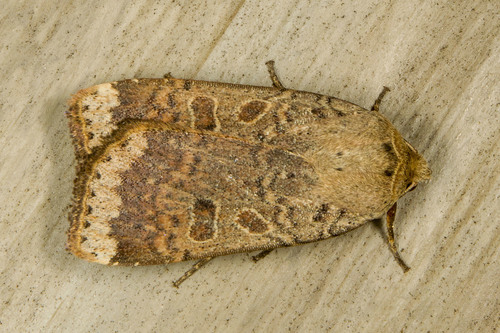


Greater Red Dart
abagrotis alternata
The Greater Red Dart (Abagrotis alternata) is a fascinating nocturnal moth belonging to the Noctuidae family, commonly known as "owlet moths." This species is primarily recognized by its distinctive forewing patterns, which include reddish-brown hues and prominent dark markings. It plays a crucial role in its ecosystem as both a pollinator in its adult stage, feeding on nectar, and as a primary consumer in its larval stage, where caterpillars feed on the foliage of various plants. Its life cycle, from egg to larva to pupa and finally to a winged adult, showcases a remarkable transformation. Despite its relatively small size, the Greater Red Dart contributes significantly to the biodiversity of the habitats it occupies, often serving as a food source for various insectivores.
Lebensraum: Found in a variety of habitats including deciduous and mixed forests, open woodlands, fields, and suburban gardens where host plants and nectar sources are abundant.
The Greater Red Dart is a medium-sized moth, typically exhibiting forewings with a base color ranging from pale yellowish-brown to a richer reddish-brown. A key identifying feature is the prominent, dark, dart-like marking that extends from the base of the forewing towards the middle, often outlined in a lighter shade. The hindwings are usually a plainer, duller gray or brown, lacking significant markings. Its body is stout and covered in fine hairs, matching the wing coloration.
Kategorie
InsektenSeltenheit
Common
Gefahr
1/5 · Sehr gering
Snaps
Mach den ersten Snap!
Adult Greater Red Darts are attracted to sap flows on trees, as well as overripe fruit, in addition to flower nectar.
Like many moths in the Noctuidae family, the Greater Red Dart's caterpillars are sometimes referred to as 'cutworms' due to their habit of cutting down young plants at the soil line, though this species is generally not considered a major agricultural pest.
The common name 'Dart' refers to the moth's often rapid and direct flight pattern, especially when disturbed.
The species typically overwinters as a pupa in the soil or leaf litter, emerging as an adult moth in late summer.
The mottled brown and reddish patterns on its forewings allow it to blend seamlessly with tree bark, leaf litter, or dried vegetation during its resting hours, effectively evading visual predators like birds.
When disturbed, the Greater Red Dart can execute rapid, erratic flight patterns, making it difficult for predators such as bats or nocturnal birds to track and capture it.
Adults possess a long, coiled proboscis, a tube-like mouthpart, which allows them to efficiently extract nectar from deep within various flowers, contributing to pollination.
Adult Greater Red Darts are nectarivorous, feeding on the sweet liquids produced by flowering plants. Their caterpillars, however, are herbivorous, consuming the leaves of a variety of woody plants and shrubs.
Altersunterschiede: Larvae (caterpillars) feed exclusively on plant foliage, while the adult moths feed solely on nectar.
Turdus migratorius
Larvae consumed by insectivorous birds.
Eptesicus fuscus
Adults are preyed upon by nocturnal flying mammals.
Quercus rubra
Larvae feed on the leaves of this tree.
Solidago canadensis
Adults feed on nectar from these flowers.
Für dieses Objekt sind noch keine Merkmal-Badges vergeben.
Noch keine Alternativnamen vorhanden.
Sammlungen für dieses Objekt erscheinen hier, wenn weitere Themen hinzugefügt werden.
Gefahr
1/5 · Sehr gering
Noch keine besonderen Sicherheitshinweise.
Der einfachste Weg, Greater Red Dart zu bestimmen, ist die Verwendung der Naturführer-App Snappit.
1-2 cm
3-4 cm
0.0005-0.0015 kg
0-1 Jahre
15 km/h
Adult Greater Red Darts are nectarivorous, feeding on the sweet liquids produced by flowering plants. Their caterpillars, however, are herbivorous, consuming the leaves of a variety of woody plants and shrubs.
Found in a variety of habitats including deciduous and mixed forests, open woodlands, fields, and suburban gardens where host plants and nectar sources are abundant.
Zoome hinein, um Cluster aufzulösen und zu sehen, wo dieses Objekt fotografiert wurde.
Neueste Snaps erscheinen hier, wenn neue Beobachtungen hinzukommen.














