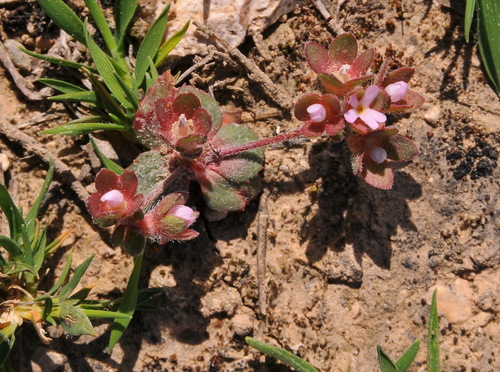


Greater Rock-Jasmine
androsace maxima
The Greater Rock-Jasmine (Androsace maxima) is a charming, often overlooked annual herb belonging to the Primulaceae family, which also includes primroses. Despite its delicate appearance, this plant is a resilient colonizer of various open and disturbed habitats across its vast Eurasian range. It completes its entire life cycle within a single growing season, making the most of favorable conditions before they become too harsh. Its small stature and subtle beauty belie its ecological importance in stabilizing disturbed soils and providing early season floral resources.
Lebensraum: Typically found in dry, open habitats such as rocky slopes, grasslands, fallow fields, and disturbed ground.
This diminutive plant typically grows 3 to 15 centimeters tall, featuring a basal rosette of oblong to obovate, often hairy leaves. From the center of this rosette arise slender stems topped with clusters (umbels) of tiny, radially symmetrical flowers. Each flower is small, usually white or pale pink, with five petals, and often has a yellowish 'eye' at its center. Its overall appearance is humble and low-growing, blending easily into its environment.
Kategorie
PflanzenSeltenheit
Common
Gefahr
1/5 · Sehr gering
Snaps
Mach den ersten Snap!
Despite its common name, 'Rock-Jasmine,' Androsace maxima is not closely related to true jasmine (genus Jasminum), which belongs to the olive family.
It is sometimes grown as an ornamental plant in rock gardens for its charming, delicate flowers and compact growth habit.
Its ability to thrive in poor, rocky soils makes it an important pioneer species in ecological succession, helping to stabilize disturbed ground.
The 'maxima' in its scientific name (meaning 'largest') refers to it being comparatively larger than some other species within the Androsace genus, though it remains a very small plant.
Androsace maxima is well-adapted to arid conditions, capable of surviving prolonged dry spells common in its natural habitat by completing its life cycle rapidly.
As an annual plant, it germinates, grows, flowers, and produces seeds within a single season, allowing it to capitalize on transient periods of favorable moisture and temperature.
It produces numerous small, lightweight seeds that can be easily dispersed by wind or small disturbances, enabling rapid colonization of new or disturbed areas.
As a photosynthetic plant, Androsace maxima produces its own food by converting light energy into chemical energy, primarily absorbing water and essential minerals from the soil.
Altersunterschiede: Nutrient requirements may vary slightly between seedling and mature plant stages as biomass increases.
Ceratina cyanea
Pollinator for its small flowers, contributing to reproduction.
Microtus agrestis
Potential herbivore that may graze on its leaves and stems, especially when young.
Papaver rhoeas
Competitor for light, water, and soil nutrients in shared habitats.
Für dieses Objekt sind noch keine Merkmal-Badges vergeben.
Noch keine Alternativnamen vorhanden.
Sammlungen für dieses Objekt erscheinen hier, wenn weitere Themen hinzugefügt werden.
Gefahr
1/5 · Sehr gering
Noch keine besonderen Sicherheitshinweise.
Der einfachste Weg, Greater Rock-Jasmine zu bestimmen, ist die Verwendung der Naturführer-App Snappit.
3-15 cm
0.001-0.005 kg
0-1 Jahre
As a photosynthetic plant, Androsace maxima produces its own food by converting light energy into chemical energy, primarily absorbing water and essential minerals from the soil.
Typically found in dry, open habitats such as rocky slopes, grasslands, fallow fields, and disturbed ground.
Photosynthesis And Nutrient Absorption
100-1000
Zoome hinein, um Cluster aufzulösen und zu sehen, wo dieses Objekt fotografiert wurde.
Neueste Snaps erscheinen hier, wenn neue Beobachtungen hinzukommen.