.jpg&width=800)





Greater Short-horned Lizard
Phrynosoma hernandesi
The Greater Short-horned Lizard is a small, spiky lizard that loves to bask in the sun. It can change colors to blend in with its surroundings, making it a great little hide-and-seek player in the wild!
Lebensraum: Desert
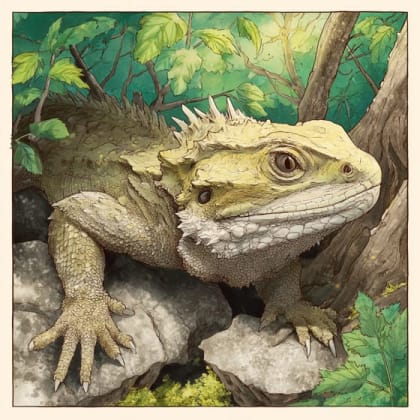
The Greater Short-horned Lizard is a flat-bodied reptile with a spiky appearance, featuring a row of short, horn-like spines on its head. Its skin is typically mottled brown, grey, or tan, often with darker blotches, providing excellent camouflage against rocky or sandy ground.
Kategorie
ReptilienSeltenheit
Common
Gefahr
1/5 · Sehr gering
Snaps
Mach den ersten Snap!
Its 'horns' are actually modified scales, not true horns like on a bull.
They can survive freezing temperatures by burying themselves in the soil!
They use a special glue-like substance on their tongue to catch ants!
Unlike most lizards, this species gives birth to live babies, not eggs!
Greater Short-horned Lizards can squirt a stream of blood from their eyes that helps them scare away predators like coyotes.
Greater Short-horned Lizards have sharp, bony spines all over their body that helps them become a prickly, tough meal for predators.
Greater Short-horned Lizards have mottled skin colors and a flat body that helps them blend perfectly into their surroundings.
Tiny hunters, they mainly feast on ants, gulping them down with their specialized tongue!

Pogonomyrmex occidentalis
A main food source, caught with a sticky tongue.
Formica fusca
Common ant species preyed upon by the lizard.
Buteo jamaicensis
A common avian predator hunting from the sky.
Canis latrans
Mammalian predator that hunts them on the ground.
Pituophis catenifer
A snake known to prey on small lizards.
Einzelgänger leben den größten Teil ihres Lebens allein und interagieren mit Artgenossen nur zur Paarung oder zur Aufzucht der Jungen.
Getarnt beschreibt Organismen, die über eine Färbung oder Musterung verfügen, durch die sie mit ihrer Umgebung verschmelzen.
Dieses Merkmal kennzeichnet Organismen, deren Nahrung hauptsächlich aus Insekten und anderen kleinen Wirbellosen besteht.
Wüstenlebensräume sind trockene Regionen, die durch extrem geringen Niederschlag und oft extreme Temperaturen gekennzeichnet sind und eine spezialisierte Flora und Fauna beherbergen.

Besitzt scharfe, spitze Vorsprünge oder Stacheln auf dem Körper oder der Oberfläche.

Dieses Merkmal kennzeichnet Organismen, deren Ernährung vollständig oder hauptsächlich aus tierischem Gewebe besteht.

Tagaktive Tiere sind hauptsächlich bei Tageslicht aktiv und ruhen oder schlafen in der Regel nachts.
Gefahr
1/5 · Sehr gering
Don't touch wild lizards; they are best admired from a distance.
7-15 cm
0.015-0.07 kg
5-8 Jahre
1.5 km/h
Tiny hunters, they mainly feast on ants, gulping them down with their specialized tongue!
Desert
Ambush
Zoome hinein, um Cluster aufzulösen und zu sehen, wo dieses Objekt fotografiert wurde.
Neueste Snaps erscheinen hier, wenn neue Beobachtungen hinzukommen.