






Guinea Paper Wasp
polistes exclamans
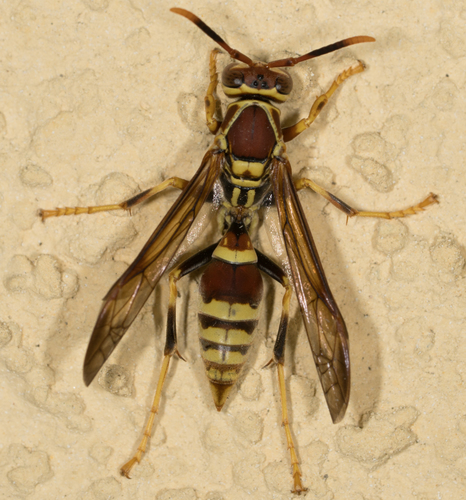
The Guinea Paper Wasp is a fascinating insect that builds its home from paper-like material made from plant fibers. These wasps are known for their unique yellow and black markings and can often be seen buzzing around flowers and trees!
Lebensraum: Guinea Paper Wasps are commonly found in gardens, forests, and areas with plenty of flowers.
The Guinea Paper Wasp has a slender, reddish-brown body with distinct yellow bands on its abdomen and a primarily black head with some yellow. Its smoky brown wings are often folded lengthwise when at rest, making it appear streamlined and distinct from other wasps.
Kategorie
InsektenSeltenheit
Common
Gefahr
2/5 · Gering
Snaps
Mach den ersten Snap!
A new queen starts her entire paper nest colony all by herself!
Some worker wasps can even lay eggs if the queen disappears!
They shake their bodies to signal danger to other wasps in the nest!
Wasp larvae eat chewed-up caterpillars caught by their hunting mothers!
Guinea Paper Wasps can build impressive paper nests from chewed plant fibers and saliva that protect their young.
Guinea Paper Wasps have a venomous sting that helps them defend their colony from threats and subdue prey.
Guinea Paper Wasps can hunt and capture soft-bodied insects like caterpillars to feed their developing larvae.
Adults drink nectar, while larvae feast on insects like caterpillars caught by adults.
Altersunterschiede: Larvae are fed chewed-up insects, while adult wasps primarily consume nectar and sweet plant secretions.
Manduca sexta
Wasps catch and chew these caterpillars to feed their young.

Asclepias syriaca
Adult wasps visit flowers like milkweed to drink nectar for energy.
Turdus migratorius
Birds like robins may sometimes prey on adult wasps or their larvae.
Soziale Tiere leben in organisierten Gruppen und kooperieren, um ihr Überleben zu sichern, beispielsweise bei der Nahrungssuche, Verteidigung und Aufzucht der Jungen.
Farbenfroh beschreibt Organismen oder Objekte, die eine große Vielfalt an leuchtenden und deutlich erkennbaren Farben aufweisen.
Dieses Merkmal kennzeichnet Organismen, deren Ernährung vollständig oder hauptsächlich aus tierischem Gewebe besteht.
Tagaktive Tiere sind hauptsächlich bei Tageslicht aktiv und ruhen oder schlafen in der Regel nachts.

Beschreibt Organismen, die Pollen übertragen und so die Befruchtung und Fortpflanzung von Pflanzen ermöglichen.
Gefahr
2/5 · Gering
Be cautious around nests, as they may sting if they feel threatened.
25-35 mm
15-20 mm
20-365 Tage
15-25 km/h
Adults drink nectar, while larvae feast on insects like caterpillars caught by adults.
Guinea Paper Wasps are commonly found in gardens, forests, and areas with plenty of flowers.
Foraging
6
Zoome hinein, um Cluster aufzulösen und zu sehen, wo dieses Objekt fotografiert wurde.
Neueste Snaps erscheinen hier, wenn neue Beobachtungen hinzukommen.















_female_underside.jpg&width=800)