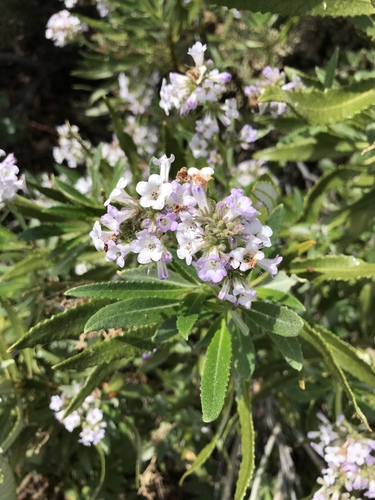


Hairy Yerba Santa
eriodictyon trichocalyx
Hairy Yerba Santa (Eriodictyon trichocalyx) is a resilient, evergreen shrub native to the arid mountains and foothills of Southern California and Baja California. Belonging to the borage family, this woody perennial is famous for its heavily textured, aromatic foliage and sticky, resinous leaves. Historically revered by Native American tribes and early Spanish settlers, who dubbed it the 'holy herb' (Yerba Santa), it has a rich ethnobotanical history of medicinal use, particularly for treating respiratory ailments. In the chaparral ecosystem, Hairy Yerba Santa serves as a vital pioneer species, readily colonizing disturbed soils and burn areas to help stabilize the ground after wildfires while providing sustenance to local fauna.
Lebensraum: Typically found on dry, sunny slopes and ridges in chaparral, coastal sage scrub, and yellow pine forest communities.
This woody shrub typically grows between 60 to 200 centimeters tall, forming dense mounds of dark green, leathery foliage. Its lance-shaped leaves are highly distinctive, featuring deeply set veins, finely serrated margins, and a sticky coating of shiny resin on the upper surface, while the undersides are blanketed in a dense mat of white, woolly hairs. From spring to early summer, the plant produces dense, branching clusters of small, tubular flowers that range in color from pale lavender to white, surrounded by fuzzy, hair-covered calyces.
Kategorie
PflanzenSeltenheit
Common
Gefahr
1/5 · Sehr gering
Snaps
Mach den ersten Snap!
Spanish missionaries were so impressed by the plant's ability to soothe coughs and respiratory issues that they named it 'Yerba Santa', meaning 'Holy Herb'.
The leaves of Hairy Yerba Santa contain eriodictyol, a compound that can temporarily mask bitter tastes, which led to its historical use in flavoring bitter medicines.
The sticky resin on the leaves was historically chewed like chewing gum by indigenous peoples to stave off thirst in dry Mediterranean climates.
The undersides of the leaves are covered in a dense layer of interlocking white hairs called trichomes, which trap a micro-layer of humid air and reduce water loss through transpiration.
The upper surfaces of the leaves secrete a thick, sticky resin that acts as a natural sunblock and prevents parching desert winds from drying out vital tissues.
This species possesses underground rhizomes that survive intense wildfires, allowing it to quickly resprout and dominate cleared landscapes post-fire.
As a photoautotroph, Hairy Yerba Santa produces its own energy by converting sunlight, carbon dioxide, and water into sugars through photosynthesis.
Euphydryas chalcedona
The caterpillar of this butterfly species uses Yerba Santa as a primary host plant, feeding heavily on its leaves.
Apis mellifera
Bees visit the fragrant spring flowers to collect nectar, acting as key pollinators for the shrub.
Neotoma lepida
Woodrats may feed on the foliage and use the woody stems of the shrub to construct their complex middens.
Für dieses Objekt sind noch keine Merkmal-Badges vergeben.
Noch keine Alternativnamen vorhanden.
Sammlungen für dieses Objekt erscheinen hier, wenn weitere Themen hinzugefügt werden.
Gefahr
1/5 · Sehr gering
Noch keine besonderen Sicherheitshinweise.
Der einfachste Weg, Hairy Yerba Santa zu bestimmen, ist die Verwendung der Naturführer-App Snappit.
60-200 cm
10-30 Jahre
As a photoautotroph, Hairy Yerba Santa produces its own energy by converting sunlight, carbon dioxide, and water into sugars through photosynthesis.
Typically found on dry, sunny slopes and ridges in chaparral, coastal sage scrub, and yellow pine forest communities.
Zoome hinein, um Cluster aufzulösen und zu sehen, wo dieses Objekt fotografiert wurde.
Neueste Snaps erscheinen hier, wenn neue Beobachtungen hinzukommen.













