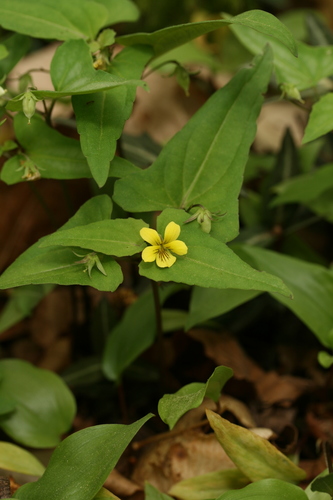


Halberd-Leaved Violet
viola hastata
The Halberd-Leaved Violet (Viola hastata) is a charming and distinctive perennial herb native to the woodlands of the eastern United States. Unlike the classic heart-shaped leaves of most familiar violets, this species stands out with its striking, spear-like foliage that earned it its common name. Emerging in the dappled sunlight of early spring forests, it adds a bright splash of cheerful yellow to the muted tones of the deciduous leaf litter. This plant is a true specialist of the Appalachian forest understory. It has evolved fascinating survival strategies, such as relying on woodland ants for seed dispersal and producing secret, self-pollinating flowers later in the season to ensure its reproduction even if spring pollinators fail to arrive. For woodland hikers and botany enthusiasts, spotting its silver-mottled leaves and vibrant blooms is a delightful and unmistakable sign of spring.
Lebensraum: Found primarily in the rich, dry to mesic soils of deciduous and mixed hardwood forests, especially throughout the Appalachian Mountains.
Viola hastata typically grows 10 to 25 centimeters tall, featuring a smooth, largely unbranched stem with leaves primarily clustered near the top. The most diagnostic feature is its hastate (halberd-shaped) leaves, which are elongated, sharply pointed, and feature distinctively flared lobes at the base. These dark green leaves are often beautifully mottled with silvery-white or pale green patches. In April and May, it produces solitary, nodding flowers with five petals. The blooms are a vibrant yellow, with the lowest petal prominently marked by dark brownish-purple veins that act as visual nectar guides for visiting insects.
Kategorie
PflanzenSeltenheit
Common
Gefahr
1/5 · Sehr gering
Snaps
Mach den ersten Snap!
The common name 'halberd-leaved' is inspired by the leaf's distinct shape, which resembles the head of a medieval two-handed pole weapon known as a halberd.
The dark purple veins on its bright yellow petals aren't just for show; they act as 'landing lights' that reflect ultraviolet light, guiding bees directly to the flower's nectar.
To ensure its survival in the shady understory, this violet essentially creates a reproductive backup plan by producing secret, self-pollinating flowers hidden tightly under its leaves in late summer.
Produces seeds equipped with a nutrient-rich, fatty appendage called an elaiosome, which tricks ants into carrying the seeds back to their underground nests where they are safely planted.
Grows a secondary set of small, closed, bud-like flowers near the ground in the summer that self-pollinate, guaranteeing seed production even when insect pollinators are scarce.
Features distinct silvery mottling on its spear-shaped leaves, a trait believed to help camouflage the plant from herbivores against the sun-flecked forest floor.
As a photosynthetic plant, the Halberd-Leaved Violet produces its own food using sunlight, carbon dioxide, and water.
Aphaenogaster picea
Disperses the violet's seeds by carrying them to their nests to consume the attached elaiosome.
Speyeria cybele
Relies on the foliage of violets as an exclusive host plant during their larval caterpillar stage.
Andrena carlini
Visits the yellow spring flowers to gather nectar and pollen, directly aiding in cross-pollination.
Für dieses Objekt sind noch keine Merkmal-Badges vergeben.
Noch keine Alternativnamen vorhanden.
Sammlungen für dieses Objekt erscheinen hier, wenn weitere Themen hinzugefügt werden.
Gefahr
1/5 · Sehr gering
Noch keine besonderen Sicherheitshinweise.
Der einfachste Weg, Halberd-Leaved Violet zu bestimmen, ist die Verwendung der Naturführer-App Snappit.
10-25 cm
3-10 Jahre
As a photosynthetic plant, the Halberd-Leaved Violet produces its own food using sunlight, carbon dioxide, and water.
Found primarily in the rich, dry to mesic soils of deciduous and mixed hardwood forests, especially throughout the Appalachian Mountains.
Photosynthesis
10-40
Zoome hinein, um Cluster aufzulösen und zu sehen, wo dieses Objekt fotografiert wurde.
Neueste Snaps erscheinen hier, wenn neue Beobachtungen hinzukommen.















