

Harlequin Monkeyflower
diplacus bicolor
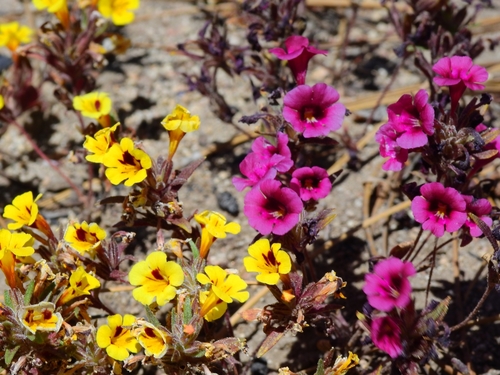
The Harlequin Monkeyflower (Diplacus bicolor) is a charming annual herb native to the foothills and mountain slopes of California and southern Oregon. Celebrated for its striking two-toned blossoms, this diminutive plant bursts into bloom during the spring, painting grassy slopes, chaparral, and open woodlands with vibrant splashes of yellow and white. It is an important component of its native ecosystems, attracting a variety of native pollinators with its specialized floral structure. Historically grouped under the genus Mimulus, this species thrives in vernal clay soils and moist, open areas. Its cheerful flowers resemble tiny mask-like faces, a characteristic feature of the monkeyflower family that has long delighted hikers, botanists, and nature enthusiasts alike.
Lebensraum: Found in moist, grassy slopes, chaparral, open yellow pine forests, and clay soils of foothill woodland ecosystems.
This small annual wildflower typically grows between 4 and 27 centimeters tall, with slender, sticky stems and oppositely arranged, linear leaves. The most defining feature is its snapdragon-like, two-lipped flower: the upper lip is pure white or pale pink, while the lower lip is bright yellow and adorned with dark purple or reddish dots that serve as nectar guides. The tubular base of the flower is narrow, widening into five distinct lobes that give it a distinctive asymmetric, face-like appearance.
Kategorie
PflanzenSeltenheit
Common
Gefahr
1/5 · Sehr gering
Snaps
Mach den ersten Snap!
Its glandular, sticky leaves act as a natural defense system, making it difficult for crawling pests to feed on the plant.
The common name 'monkeyflower' comes from the shape of the blossoms, which some observers think resemble the face of a smiling monkey.
The species name 'bicolor' highlights its striking two-toned look, combining stark white upper petals with a bright golden-yellow lower lip.
The contrasting white-and-yellow petals paired with dark purple dots act as highly effective visual runways, guiding specific native bees directly to the nectar source.
The stems and leaves are covered in glandular hairs that exude a sticky substance, discouraging small crawling herbivores and sap-sucking insects.
As an ephemeral annual, it completes its lifecycle rapidly during the wet spring months, producing abundant small seeds that lie dormant in the soil through the dry summer.
As a photoautotrophic plant, the Harlequin Monkeyflower generates its own energy from sunlight, water, and carbon dioxide through photosynthesis.
Bombus vosnesenskii
Serves as a primary pollinator, seeking nectar and transferring pollen between flowers.
Euphydryas chalcedona
The caterpillars of this butterfly species feed on the leaves of monkeyflowers.
Für dieses Objekt sind noch keine Merkmal-Badges vergeben.
Noch keine Alternativnamen vorhanden.
Sammlungen für dieses Objekt erscheinen hier, wenn weitere Themen hinzugefügt werden.
Gefahr
1/5 · Sehr gering
Noch keine besonderen Sicherheitshinweise.
Der einfachste Weg, Harlequin Monkeyflower zu bestimmen, ist die Verwendung der Naturführer-App Snappit.
4-27 cm
bis zu 1 Jahre
As a photoautotrophic plant, the Harlequin Monkeyflower generates its own energy from sunlight, water, and carbon dioxide through photosynthesis.
Found in moist, grassy slopes, chaparral, open yellow pine forests, and clay soils of foothill woodland ecosystems.
Zoome hinein, um Cluster aufzulösen und zu sehen, wo dieses Objekt fotografiert wurde.
Neueste Snaps erscheinen hier, wenn neue Beobachtungen hinzukommen.